Most lists of digital product ideas fail the same way: they name categories rather than products. Sell an ebook. Sell a course. Sell templates. None of that tells you what to make on Saturday morning, and none of it explains why the person next to you sold forty copies of a spreadsheet while your carefully built course sold two.
The ideas below are sorted by what you already have, because that is the only sorting that helps a beginner. Each one can be finished by a person with no audience, no design background and no budget for freelancers. The list is followed by a filter that kills weak ideas in four questions, and a test that gets you real evidence in a week without building the thing first.
The short answer
Your first digital product should come from something you have already done for another person: a question you have answered more than once, a file you built to survive your own work, or a story you have told out loud. Make the smallest complete version of it, sell it before it is perfect, and let the buyers tell you what version two contains. Ignore trending niche lists entirely at this stage, because they point you at markets you have no evidence about and no advantage in. The rest of the machinery, from listing to delivery to repeat sales, is laid out in our complete look at how digital selling actually operates.
Where a first digital product idea really comes from
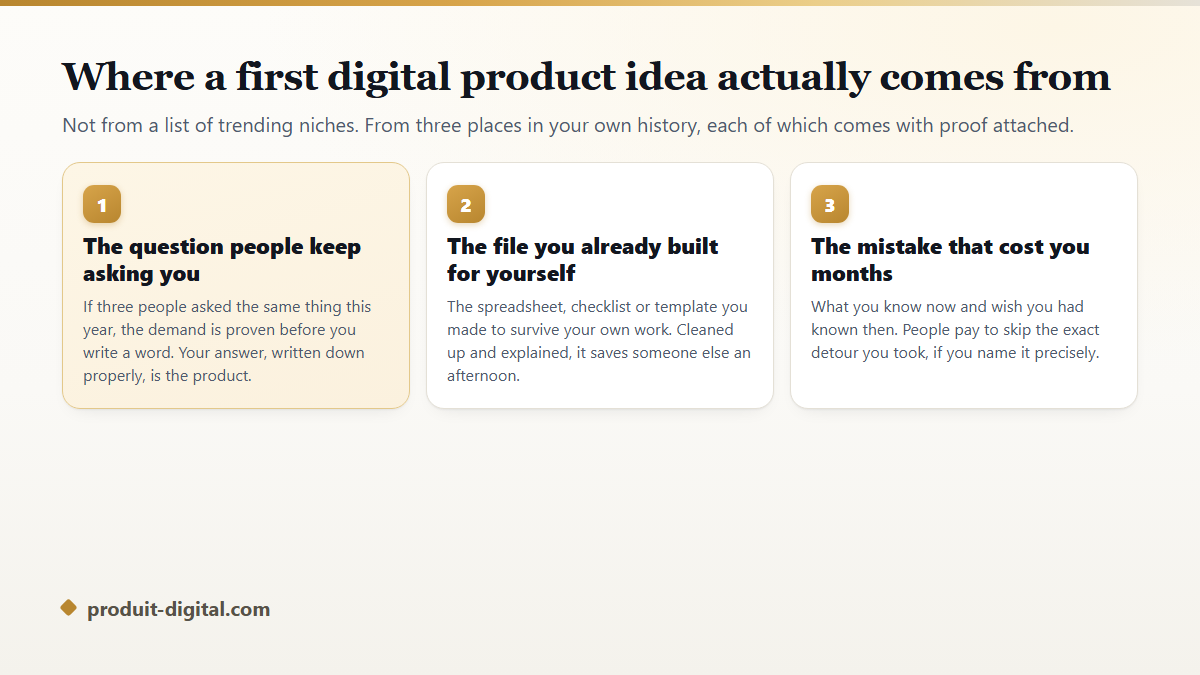
Searches for digital product ideas and digital products ideas mostly return the same catalogue of trends, and trends are the worst possible starting point for a beginner. A trending market is one where a hundred better resourced sellers arrived first, you have no unfair advantage, and you have never met the buyer. You would be guessing at every decision from the title to the cover.
Three sources give you an idea with proof already attached. The question people keep asking you means demand exists and you know the exact words buyers use. The file you built for yourself means the product is half made and you know it works, because you rely on it. The mistake that cost you months means you can describe a specific pain precisely, which is the single hardest thing to fake in a sales page. Amandine's first product was the pricing spreadsheet she built when her own bakery orders got out of hand, and it sold because every line of the listing came from her own week.
The four question filter
Run every idea through these four questions before you spend a weekend on it. An idea that fails two of them is not a bad idea, it is a later idea, and writing it on a separate page keeps it from quietly eating your month.
- Can you name one real person who would buy it? Not a demographic. A person, with a name and a situation you could describe in three sentences.
- Can you finish a complete version in under a month of evenings? Half a great product earns nothing, and unfinished projects are what stop most people from ever having a second idea.
- Do buyers already search for this kind of thing? Templates, planners, guides and children's books are formats people look for. Frameworks and systems are words sellers invented.
- Would you be able to answer questions about it for a year? Every product generates buyer questions, and a subject you are bored of becomes a burden fast.
- Is there something in it only you could have written? One real example, one specific opinion, one number from your own experience is what separates your file from every generic version of it.
Twenty digital product ideas beginners can finish
These are sorted by the raw material you already own rather than by category, so start with the group where you can answer yes immediately. Searches for digital products to sell for beginners usually surface the same generic five, and the reason so few of them work out is that the person building them had no head start on any of them.
Built on something you have explained out loud
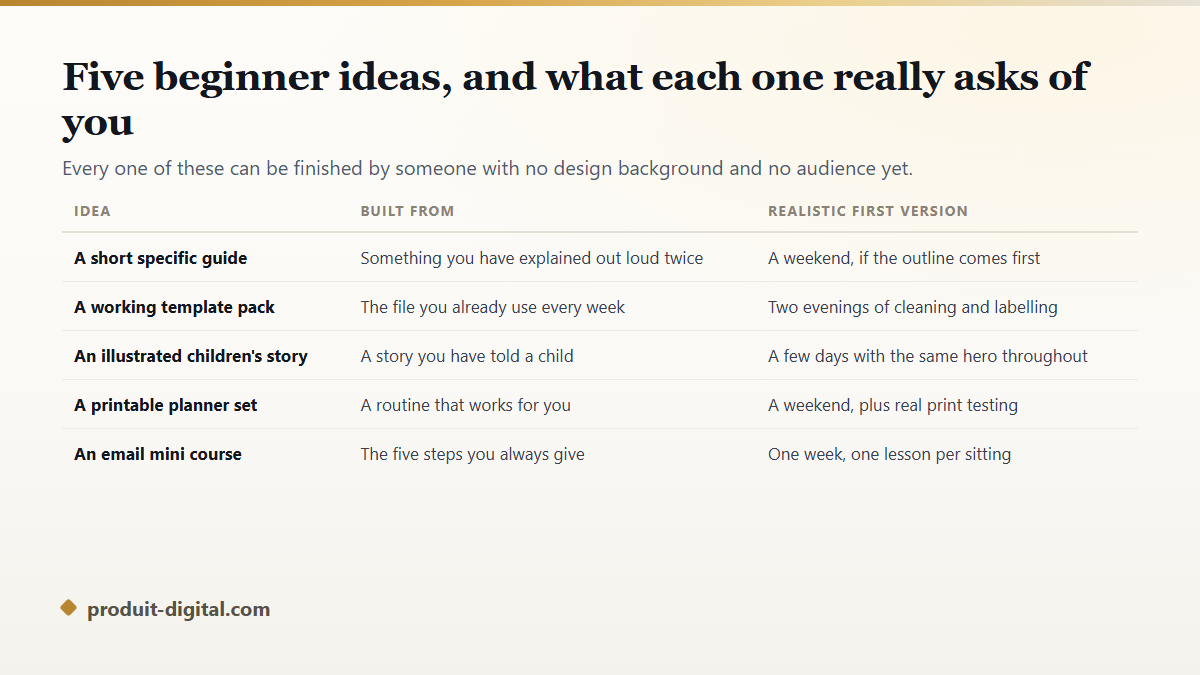
If you have explained the same thing twice, you have a product. The explanation already exists in your head in the order a beginner needs it, which is the part that normally takes weeks to get right. Write it down as a short, specific guide rather than a comprehensive one, and let its narrowness be the selling point.
- A short guide to one decision people agonize over in your field, with the criteria written out.
- A troubleshooting handbook for the ten problems you fix most often for other people.
- An email mini course that delivers the five steps you always give, one per day.
- A glossary and starter kit for a hobby that intimidates newcomers with its vocabulary.
- A comparison guide for a purchase people research for weeks and still get wrong.
Guides of this kind live comfortably as ebooks, and the production route from an approved outline through to an exported file is covered in our guide to turning a written explanation into a finished ebook. Keep the first one short. A focused forty page guide that answers one question completely outsells a two hundred page overview of a field, because the buyer can see the finish line before they pay.
Built on a file you already made
Open the folder where you keep the things you made to survive your own work. The invoicing spreadsheet, the packing checklist, the content calendar, the client onboarding document. Each of them is a product once you clean it up, label the columns for a stranger, and write half a page explaining how to use it.
- A spreadsheet that does one calculation people currently do wrong, with the formulas explained.
- A checklist pack for a process with expensive failure modes, such as a house move or a product launch.
- A contract or proposal template built for one specific trade rather than for everyone.
- A printable planner set for a routine you actually follow, tested on a real printer.
- A presentation deck skeleton for a recurring meeting nobody enjoys preparing.
Built on a story you have told
Anyone who has invented a bedtime story has the raw material for an illustrated book, and this family is far less crowded than the template market because most people assume they need an illustrator. Personalized and illustrated books also hold their value for years, since a good children's story does not go out of date the way a software guide does.
- An illustrated children's story built around one recurring character.
- A personalized book where the child's name and appearance run through every page.
- A family recipe book with the stories behind the dishes, laid out for print.
- A memory book for a specific occasion, sold as a fill-in template other families can use.
- A short illustrated fable series, sold as a set rather than one at a time.
The one thing this family demands is visual consistency, because a hero whose hair and age shift between pages reads as cheap to adults and confusing to children. Our book workshop that keeps one hero recognizable on every page was built around exactly that constraint, which is the step that stops most first illustrated books from ever being published.
For people with no audience at all
An audience makes selling easier, and its absence is not a reason to wait. What changes without one is where the buyers come from: marketplace search instead of your mailing list. That pushes you toward products people actively type into a search box, and away from products that need explaining before anyone wants them.
- A printable pack for a seasonal event people search for every year at the same time.
- A niche wall art set for a specific room, style or profession.
- A resource pack for a hobby with an obsessive online community and few good products.
- A single PDF that answers a question with high search volume and terrible free results.
- A worksheet bundle for teachers or parents covering one narrow skill.
The ideas worth leaving for later
Some products are excellent and wrong as a first attempt. A membership commits you to producing something valuable every month indefinitely, and cancelling it damages the reputation you were building. Software carries a maintenance obligation that outlives your interest in it. A large video course takes months during which you learn nothing about whether anyone wants it, which is the most expensive form of ignorance in this whole category.
Reselling rights packs deserve their own warning. Buying a ready made product to resell looks like a shortcut, and it puts you in a market where hundreds of people are selling the identical file with the identical cover. There is nothing in it that only you could have written, which fails the last question of the filter above and leaves you competing on price alone.
Name the product the way buyers already say it
A good idea with a clever name sells to nobody, because nobody searches for a word you invented. Buyers type the format and the situation: budget planner for freelancers, bedtime stories about starting school, invoice template for photographers. Those titles look plain next to the ones sellers enjoy writing, and they are the ones that appear when somebody is actively looking to pay.
The test is short. Say your title to someone outside your field and ask them what they think is inside. If they hesitate, the title is describing your product rather than their problem. Claire spent a fortnight on a set of client onboarding documents called The Smooth Start Method, moved zero copies, and renamed it as an onboarding pack for solo web designers. The file never changed, and it began selling the same month.
Test the idea in one week, before building anything
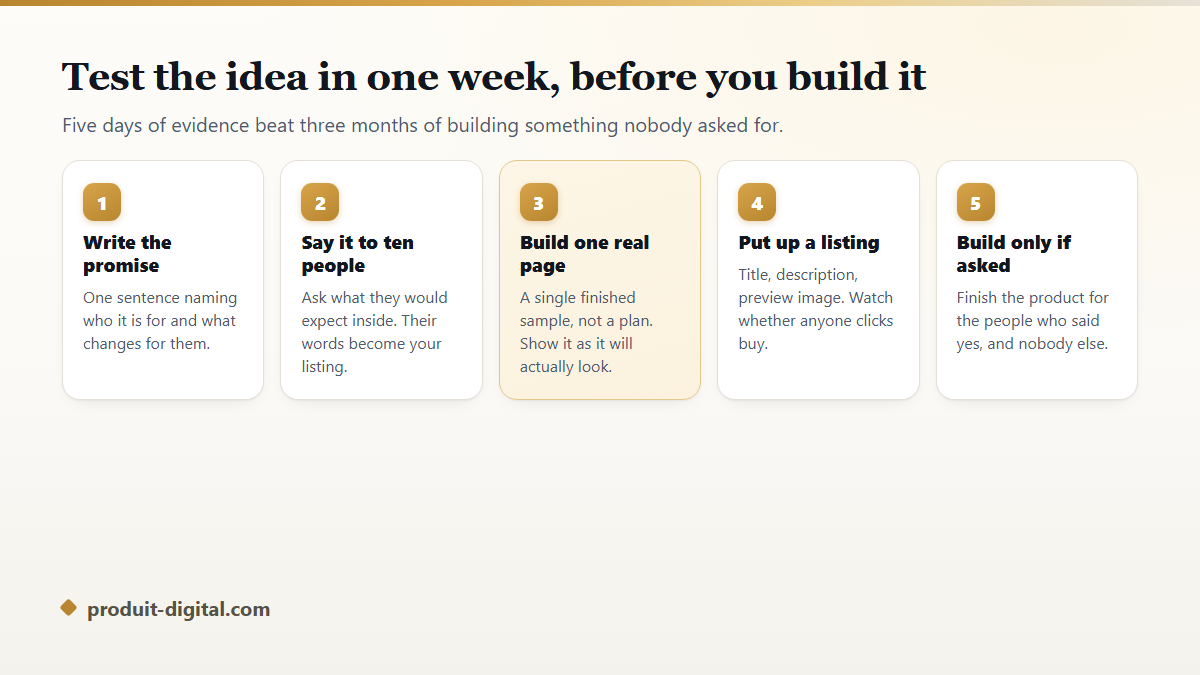
The test costs nothing and saves the three months most people lose. Write the promise as one sentence naming who it is for and what changes for them. Say that sentence to ten people who resemble the buyer and write down the words they use back at you, because those words belong in your listing far more than yours do.
Then build exactly one real page or one finished sample, not a plan and not a mockup. Put up a listing with a title, a description and that preview image, and watch whether anyone clicks buy. If nobody does, you have learned it in a week. If people do, you finish the product for them, and you now have buyers waiting rather than a folder waiting for buyers. A single well made PDF is often the right shape for that first version, and our walkthrough of taking one file to its first sale covers the delivery side.
From a validated idea to a finished file
Once the idea has passed the test, the work is production, and production is where enthusiasm quietly runs out. Decide the format first, because it determines everything after it: a reflowing ebook for text, a fixed PDF for anything with a designed page, a set of image files for printables. Then set a finish date and cut scope to fit it rather than moving the date.
Build the listing at the same time as the product, not afterward. Writing the description early exposes the parts of your product that are vague while you can still fix them, and it gives you the sample you need for the preview. If you want the wider picture of what sells in each family before committing, our survey of what digital products are and which ones move sorts the whole category into six families with real examples.
Frequently asked questions
What is the easiest digital product for a beginner to sell?
A short specific guide or a template built from a file you already use. Both can be finished in days, both are formats buyers already search for, and both teach you the underrated parts of the job: writing a listing, making a preview and setting up automatic delivery. Those skills carry over to every product you make afterward.
Do I need an audience before I start?
No, but the absence of one should change your idea. Without an audience your buyers arrive through marketplace search, so choose something people actively type into a search box rather than something that needs explaining first. Build the audience with the product rather than before it.
How do I know whether an idea has demand?
Three signals, in order of reliability. Someone has already asked you for it. Similar products exist and have recent reviews, which means the market is alive rather than empty. And people search for the format by name. An idea with none of these signals is not impossible, it just requires you to create demand as well as supply, which is two jobs instead of one.
Should I make one product or several at once?
One, finished, in front of real people. Running three in parallel usually produces three unfinished things and no information about any of them. Once the first is published you will learn more from a week of buyer questions than from a month of planning the other two.
Can I sell an idea that already exists?
Yes, and existing competition is a good sign rather than a warning, since it means people pay for this. What matters is being specific where the existing products are general. A budget template competes with thousands. A budget template built for a freelance illustrator who invoices in two currencies competes with almost none, and it is exactly as much work to make.
Pick the smallest idea you can finish this month
The first product is not meant to be your best one, it is meant to teach you the whole chain from idea to buyer while the stakes are low. Choose the group above where you already have the raw material, run it through the four questions, and give yourself a finish date you would be slightly embarrassed to miss. You can see what a finished book looks like and the steps behind it on the page that presents the whole service, or create an account and start from the outline and have something real to show ten people by the weekend.