Most people who ask how to sell digital products already have the product. It sits in a folder, exported and proofread, sometimes for months. What is missing is everything around it: a page that says who the file is for, a checkout that takes payment while you sleep, a delivery that happens without you, and some reason for a stranger to be on that page at all.
That surrounding structure is a machine with six parts, and a file that earns nothing is usually missing one part rather than failing at all six. This guide walks the chain in the order a real sale travels it, from the promise you make to the receipt the buyer keeps six months later. At each step it separates what you can postpone from what actually decides whether money moves.
The short answer
Pick one problem you can solve completely inside a file. Write the sales page before you build anything, because the page tells you what the file has to contain. Build the smallest version that solves the whole problem instead of a large version that solves half of it. Put it on a platform that already handles payment, delivery and tax so you write no code. Then spend most of your remaining hours on traffic, which is the one part that never runs itself. Choosing what to build in the first place is a separate decision, and our comparison of which product types keep earning once a category fills up covers that side of the question.
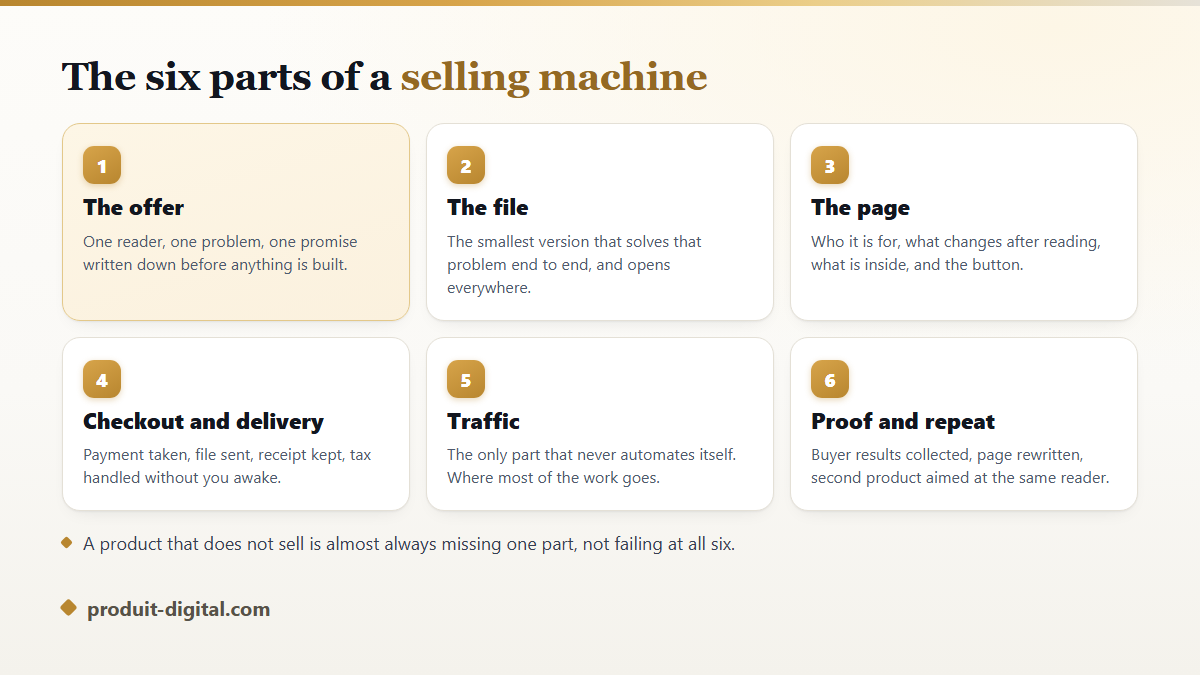
- The offer: one reader, one problem, one promise, written down before you build.
- The file: the smallest complete solution, in a format that opens on any device.
- The page: who it is for, what changes after using it, what is inside, and one button.
- Checkout and delivery: payment taken, file released, receipt kept, tax handled for you.
- Traffic: the part that stays manual, and where most of your time will go.
- Proof and repeat: buyer results collected, page rewritten, next product aimed at the same reader.
How to sell digital products in the right order
The order is not decoration. Each part sets a constraint on the next one, and skipping backward is how projects stall. The offer decides what the file must contain. The file decides what the page can honestly promise. The page decides what kind of visitor is worth sending to it. The traffic you can reach decides which selling platform makes sense. Work in that direction and every decision has an answer waiting for it.
Reverse the order and you get the common story: eight months of building, a page written in an afternoon to describe whatever got built, a marketplace chosen because a video recommended it, and then a silent launch that nobody can explain. The product is rarely the problem in that story. The sequence was.
What counts as a digital product, and what does not
A digital product is a file or a hosted resource the buyer receives without you doing anything at the moment of sale. Ebooks, printable planners, spreadsheet templates, photo presets, fonts, sample packs, short courses, workspace setups, design templates and stock photography all qualify. The shape they share is that the twentieth copy costs you what the first copy cost to deliver, which is close to nothing.
Two things sit outside that definition even though people sell them the same way. Coaching calls and custom work are services in a digital wrapper: they stop earning the moment you stop working. Memberships sit in between, since access is instant but the buyer expects new material every month. Both can be good businesses. Neither behaves like something you make once, and mixing them up is why some sellers feel busier after launch than before. The full map of the categories and how they differ is in our overview of what the term actually covers and which formats hold their value.
The offer decides everything before the file does
The offer is the sentence a stranger reads and recognizes themselves in. Julien sells a spreadsheet that tracks freelance invoices. That is a file. His offer is knowing exactly which client owes money and since when, without opening seven email threads. Same spreadsheet, two different pages, and only the second one gets bought.
Write that sentence before you build. It forces three decisions that hurt to change later: who exactly this is for, what state they are in before, and what state they are in after. If you cannot describe the reader more precisely than small business owners, the product will come out generic, and generic products lose to specific ones on every marketplace, every time.
Here is a test that takes a minute. Describe the product out loud to one real person who fits the description, in under thirty seconds. If they ask a clarifying question about who it is meant for, the offer is not sharp yet. If they ask when it will be ready, it is.
Build the smallest version that solves the whole problem
The usual failure is not building something too small. It is building something too wide. A first product that covers one problem completely sells better than one that covers four problems partially, because a buyer can tell in five seconds whether it applies to them.
Set the limit before you start: a fixed page count, one spreadsheet with three tabs, one course of four short lessons. The limit protects the launch date, and a launch date is what turns a draft into a product. Amandine spent eleven months on a course covering her entire discipline and sold none of it, then cut out the single module about the one thing people kept asking her, and that module sold in its first week.
Production has its own set of decisions, from format to file setup to what goes in the download folder, and our step by step account of turning a skill you already have into a file people can buy covers that work in full. If your product is a book or an illustrated guide rather than a template, the writing, illustration and layout chain in our path for producing an ebook from first outline to finished file is the version to follow.
Where to sell digital products online
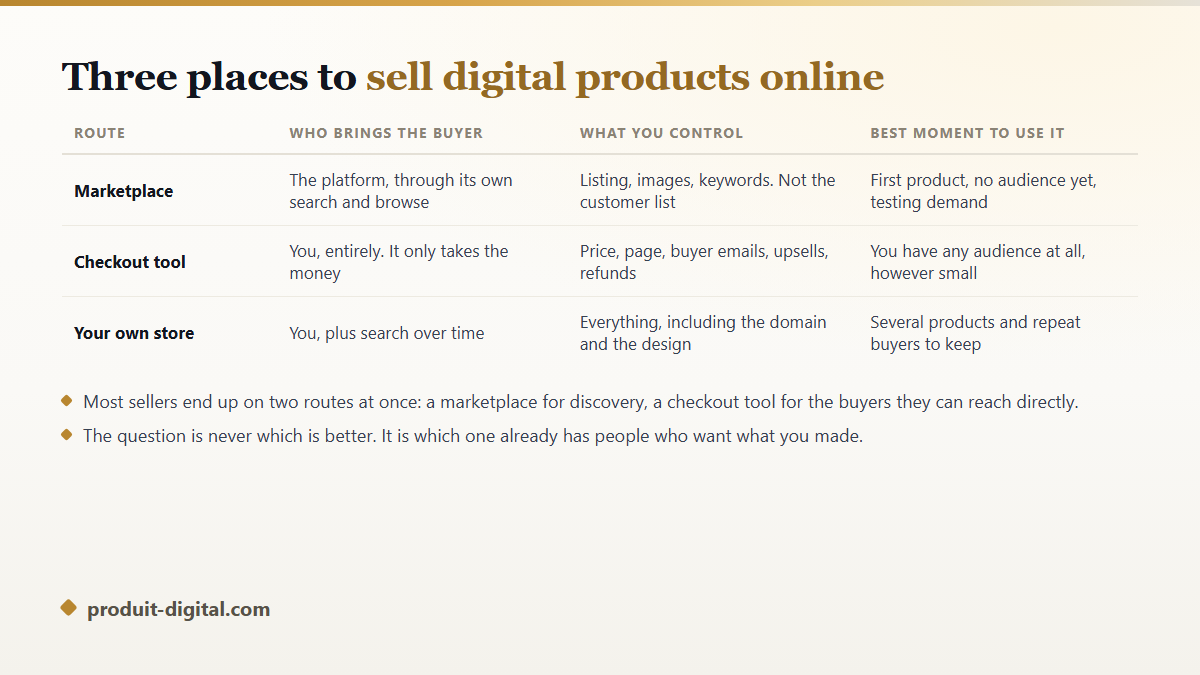
There are three routes, and they differ on a single question: who brings the buyer. People searching for how to sell digital products online are usually asking which of the three to start with, and the honest answer depends on whether anyone is already listening to you.
A marketplace brings its own traffic. Shoppers are already searching there, which is why a first product with no audience behind it often sells faster on a marketplace than on a page nobody visits. The trade is that the platform owns the relationship, takes a cut of every sale, sets the rules and can change them. According to Etsy's seller policies, digital files are delivered through the platform's own download system, and buyer contact details cannot be used for your own marketing.
A checkout tool sits at the other end. It charges the card, releases the file and keeps the receipt, and does nothing else: no browsing, no discovery, no visitors. Everything depends on you sending people there. In exchange you keep the buyer list, set your own price, run your own offers, and nobody can delist you overnight.
Your own store is the third route and the slowest to justify. It earns its keep once you have several products, repeat buyers and a reason for someone to browse rather than land on one page. Before that it is mostly maintenance. The full comparison, including which combinations work at which stage, is laid out in our side by side look at renting a marketplace audience against building a shop you own.
Checkout, delivery and the receipt
Three things have to happen without you: the card is charged, the file becomes available, and the buyer gets a record they can find again months later. Any platform worth using does all three. What separates them is what happens when something breaks at two in the morning, so read the refund flow and the re-download policy before you read the feature list.
Deliver a link, never the file itself as an email attachment. Attachments bounce on size limits and cannot be corrected after sending. Name the file so it still makes sense inside a crowded downloads folder, put your name and a version number inside the document, and add a short opening page telling the buyer where to start. For a single document sold on its own, the practical setup from folder to first payment is in our walkthrough of getting a PDF off your desktop and into a paying reader's hands.
Pricing without guessing
Price on the outcome, not on the page count. A one page checklist that saves someone a full working day is worth more than a long ebook they will skim once. Which means the pricing question is really a question about who you sell to, since the same file can be cheap for a business and expensive for a hobbyist.
Two habits help more than any formula. Start higher than feels comfortable and watch what happens, because a very low price on an unknown product reads as a signal about quality rather than as a bargain. And keep one cheaper entry product beside the main one, so people who are not ready to trust you with a big purchase can still become buyers. Someone who has paid you once is far likelier to pay again than a follower who never has.
Free versions are a pricing decision too. A free sample that solves one narrow slice of the problem earns you an email address and proves the quality at the same time. A free version that solves the entire problem earns you a thank you and nothing else.
Traffic is the part that does not automate
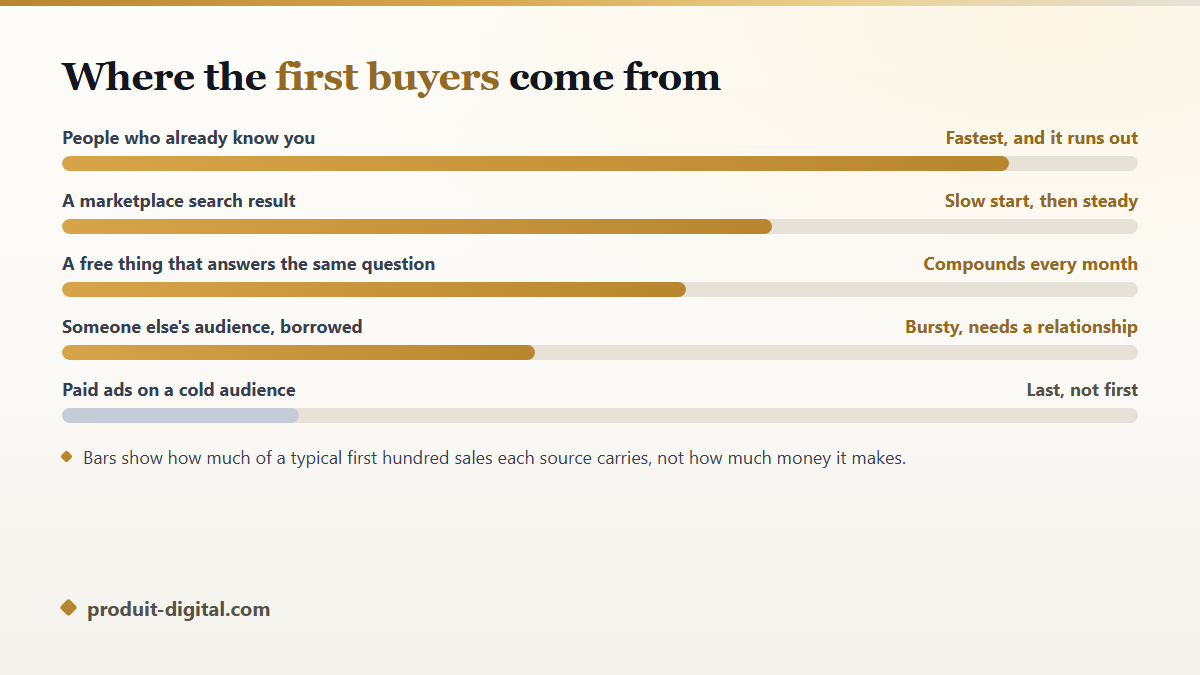
Everything above can be set up in a week. Traffic is the work that keeps going, and it is where most sellers quit. The first hundred sales almost never come from one source, so plan for several running at different speeds.
The fastest source is people who already know you, however few of them there are. A short list of readers who once asked you a question and got a useful answer will outperform a large crowd of strangers. That source runs out, which is exactly why it should be spent building the next one.
The steadiest source is search: someone typing the precise problem your product solves. It reaches you through a marketplace listing carrying the right keywords, or through free writing on your own site that answers the same question the product answers. Search is slow for a few months and then it stops being slow. Paid ads come last, once you know what a buyer is worth to you, since paying for visits to a page that does not convert only makes the loss arrive faster.
Whatever the source, the destination decides the result. Send people to a page that names the problem in their own words before it names the product, and the same traffic converts several times better.
The launch that produces the first buyers
A launch is a sequence, not an announcement. Tell the people closest to you before the page is public and ask them to buy at a reduced price in exchange for telling you exactly what confused them. Their answers become the second version of your page, and the second version is the one that sells.
- Two weeks out: talk publicly about the problem, not the product. Post the answers you already give people privately.
- One week out: show a piece of the real file. A screenshot of an actual page beats any description of it.
- Launch day: one clear message to the people who asked to hear about it, carrying the link and nothing else.
- Week one: answer every question in public, and edit the page each time the same question comes back.
- Week two: collect the first buyer results in their own words and put them on the page, replacing your adjectives with their sentences.
Refunds, piracy and the fears that stop people
Two worries kill more products than any technical problem. The first is refunds. Digital goods do attract refund requests, most of them from people who bought the wrong thing, and an exact description reduces them far more than a strict policy does. Most platforms and payment providers require a stated refund policy anyway, so write one you can honor and put it near the button rather than hiding it.
The second is piracy. Files get shared, and there is no version of selling digital products where that never happens. The practical response is to make the paid copy worth paying for: updates, the editable working file rather than a flat export, direct answers, and a place to ask questions. People who would never have paid were never buyers. According to the US Copyright Office, a work is protected from the moment it is fixed in a tangible form, while registration is what allows the owner of a US work to bring an infringement suit in federal court, which is worth knowing before you spend a weekend building watermarks.
Tax and the paperwork nobody mentions
Selling a file across borders puts you inside tax rules that follow the buyer. Under European Union VAT rules for digital services sold to private customers, the rate due is the one of the buyer's country rather than the seller's, and the seller is responsible for collecting it. In the United States, whether a digital download is taxable depends on the state. This is the main reason most sellers start on a platform that acts as merchant of record: the platform sells to the customer, carries the tax obligation, and pays you out.
Register a business when the income justifies it, or from the first sale if your country requires it, and keep every payout statement from the beginning. None of this has to be solved before your first product exists. All of it has to be understood before you build your own checkout.
What to fix when nothing sells
Diagnose in order, because the parts fail in a predictable sequence. If nobody reaches the page, the problem is traffic, and no redesign will change it. If people arrive and leave, the problem is the offer or the opening of the page: they did not recognize themselves in the first sentence. If people reach the checkout and stop, the problem is price, trust or friction at payment. If people buy and then ask for their money back, the promise did not match the file.
Each of those has a different fix, and the usual mistake is rebuilding the product when the actual situation is that fourteen people have seen the page. Count first, act second. A page with almost no visitors has no data in it, only feelings.
Making the file itself take less time
For most people the longest stretch of this chain is the product itself. Produit Digital exists for that stretch: you approve an outline before a single page is written, the text is drafted section by section, illustrations keep the same characters from one page to the next, the cover is built alongside the interior, and what comes out is a finished PDF ready to sell or print. The same project also produces the promotional pieces, so your launch material is not a second project starting from zero. The full path is on our page about writing and illustrating a complete book without stitching five separate tools together.
The rest of the machine stays identical whichever way you make the file. No production tool chooses your offer, finds your buyers or sets your price. It only gives you back the weeks that would otherwise go into layout and illustration, and those weeks are better spent on the parts that never automate.
Frequently asked questions
Do I need my own website to sell digital products?
No, and most sellers should not build one first. A marketplace listing or a checkout tool with a hosted product page is enough to take money and deliver a file on day one. A site of your own becomes useful once you have several products, an audience that browses, and writing that brings in search traffic, which is a later stage problem.
How long should the first product take to make?
Weeks rather than months. Set the scope so the first version fits inside time you can actually protect, then publish it. A product sitting in front of buyers teaches you more in ten days than another month of editing does, because buyer questions tell you precisely what the second version needs to contain.
What if someone shares my file for free?
Assume it will happen, and price on the value delivered to the people who do pay. Keep updates, editable working files and direct answers on the paid side, since a shared copy carries none of those. Chasing copies costs hours that would return far more if they went into traffic instead.
Can I sell the same product in several places at once?
Usually yes, and it is often a good idea. Read each platform's terms first, because exclusivity clauses exist: Amazon states that a book enrolled in KDP Select must have its digital edition sold nowhere else for the length of the enrollment. Outside programs like that one, listing on a marketplace while also selling from your own checkout is completely normal.
Should I start with one product or a small range?
One, finished, in front of buyers. A range only helps when every item points at the same reader, and you cannot know what that reader wants next until some of them have bought once. Let the second product answer the question your first buyers asked most often.
How much of my time goes to selling rather than making?
After the first product exists, expect the split to invert. Making is a finite job with an end date. Selling digital products is continuous: listings updated, pages rewritten, questions answered, new readers found every week. The sellers who keep earning are the ones who accepted that early instead of treating promotion as a phase.
Start with one problem and a date
The order is what carries the result: offer, file, page, checkout, traffic, proof. Pick the smallest problem you can solve completely, decide today which of the three selling routes matches the audience you already have, however small it is, and put a date on the calendar before you open a single document. You can see the whole production side on the Produit Digital home page, and you can open an account and start the outline of your first product at the Produit Digital signup page, so that by the end of the week you have something real to put in front of a buyer.