Personalized books sell because of one small moment. A child hears their own name read out loud inside a story, looks up, and checks the adult's face to see whether it was invented. That reaction is worth the whole book. So the question most buyers arrive with is not whether the idea works, but whether to order a copy from a shop that ships next week, or to build one that contains the real dog, the real grandmother and the real street.
Both routes are legitimate and they suit different situations. This guide covers what actually gets personalized in each case, what the shops do well, where a bought copy runs out of room, what making one involves in practice, and how to decide in about a minute. It also covers the part that stops most homemade attempts, which is keeping the same face on every illustration.
The short answer: buy for speed, make for meaning
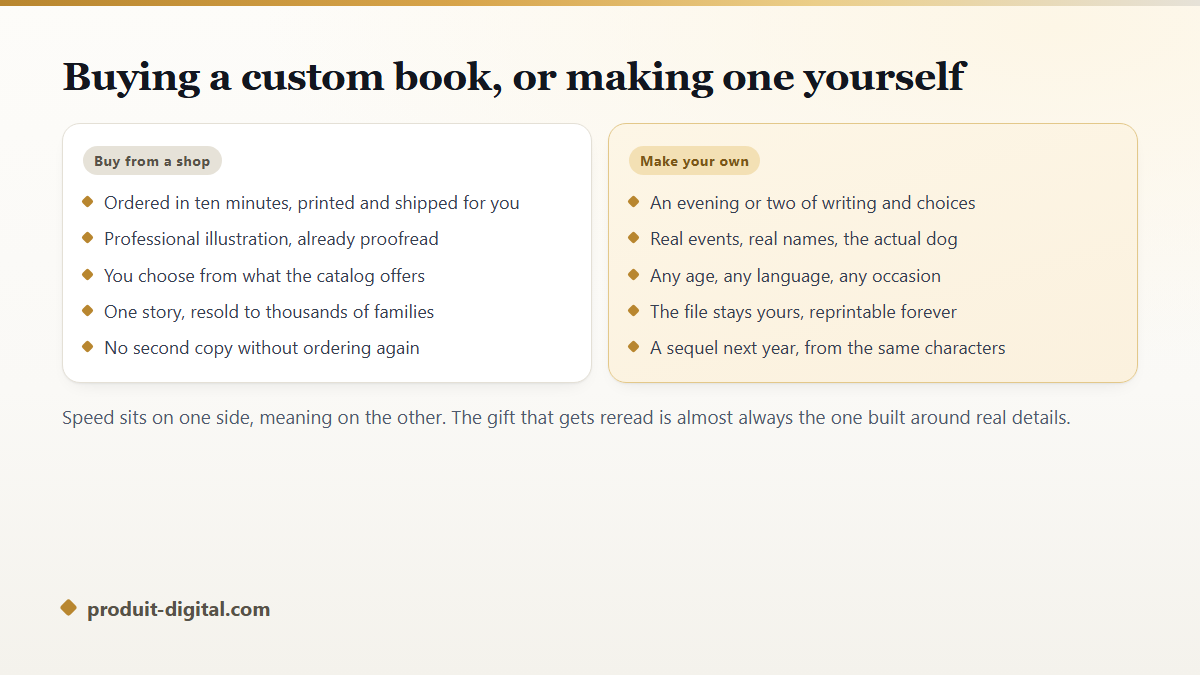
Order from a shop when the date is close, when the recipient is very small and the binding matters more than the words, or when you want professional illustration with no work on your side. Make your own when the details are the point: real names, a real house, a shared memory, an adult occasion, or several copies for several children out of one file. A bought personalized book is a good present. A made one is usually the one that survives a house move.
What actually gets personalized
The word covers four very different products, and the distance between them explains most disappointments. At the first level only a name changes, and everything else is identical for every buyer. At the second, appearance changes too, chosen from options an illustrator drew in advance. At the third, the world of the story changes: the town, the pet, the family members. At the fourth, the story itself was written for one person. Books sold for children sit mostly at the first two levels, which is why what changes for a child when the name in the story is their own matters more than the number of options a shop advertises.
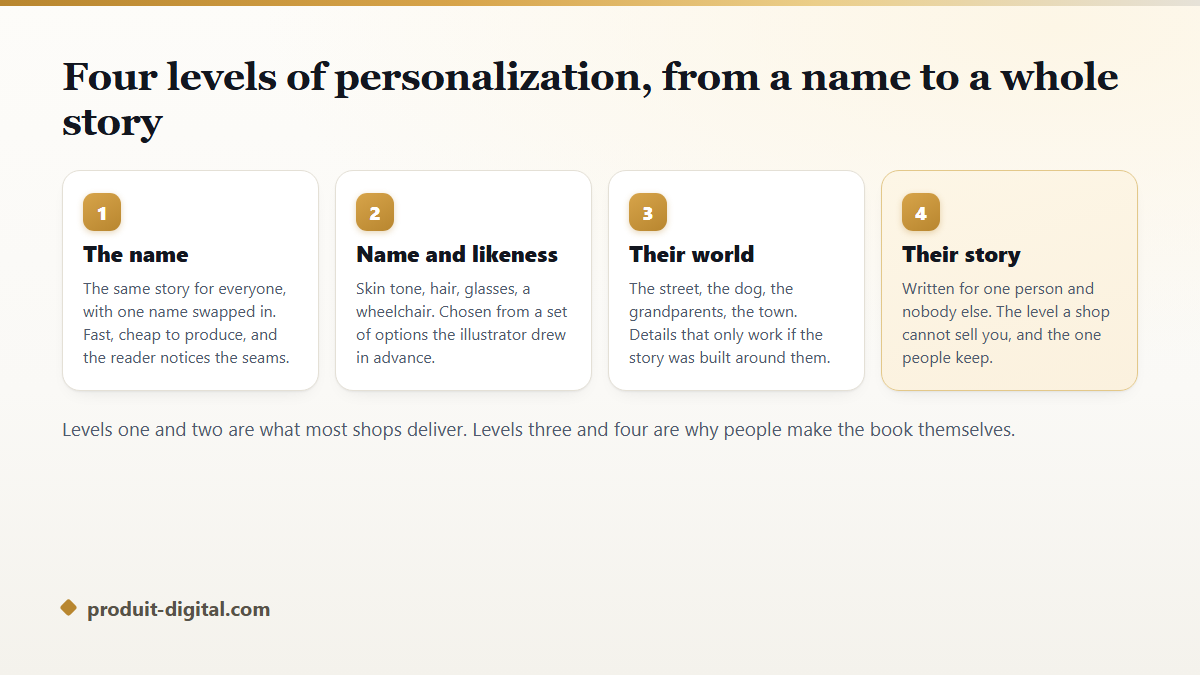
Deciding your level first saves the whole project. If a swapped name is enough, buy one this afternoon. If the point is the summer the family spent fixing a boat, no catalog can help, and you are making the book whether you planned to or not.
What the shops give you
A handful of companies built this market and built it well. Searches for I See Me personalized books usually come from parents who saw one at a baby shower: the child's name appears inside the story and often on the cover in illustrated letters. The company has been printing name based picture books for years, and the appeal is precisely its simplicity, since a buyer types a name, picks a title, and a finished book arrives.
What a shop delivers is real. The artwork was drawn by a professional, the text was edited, the printing is properly bound, and none of it asks anything from you beyond a name and a dedication. For a first birthday or a christening in a week where nobody has a spare evening, that is the correct answer.
The catalogs also cover occasions carefully: a first day at school, a new baby in the house, a lost tooth, a Christmas morning. Several shops now let you choose skin tone, hair and glasses, and a few include a wheelchair or a hearing aid, which matters a great deal to families who have never once seen a child like theirs in a picture book.
Where a bought custom book stops
Every shop title is built to be resold. The story has to work for any name, so it stays general: a quest, an alphabet, a journey through the letters of a name. The moment you want the actual holiday, the actual grandmother, or the joke only your family finds funny, the catalog has nothing, because those things cannot be templated.
The practical limits matter too. You get one copy per order, so a second child means a second purchase. Reprints depend on the shop still existing and still selling that title. Languages are limited to what the shop has translated. And the file belongs to the shop rather than to you, so the book cannot become a series unless the shop decides to make one.
Making your own custom book, step by step
Making a personalized book is a small production, and treating it like one keeps it finishable. It follows the same chain that produces any printed book, compressed into an evening or two, with the personal material decided before the writing rather than sprinkled on afterward.
- Choose one person and one occasion. A book for a named reader on a named day writes itself faster than a book for a family in general.
- List ten real details: the pet's name, the street, the phrase they repeat, the food they refuse, the place you always go.
- Pick a shape the story can hang on: a single day, a journey, a search for something lost, a year of birthdays.
- Write short. A picture book for a young child runs a few hundred words across twelve to sixteen spreads.
- Illustrate with one character who stays recognizable from the first page to the last.
- Lay out, proof and print one copy before you print six.
Those ten details are the whole trick. A story that names the neighbor's cat reads as made for the recipient even when the plot is simple, while a beautifully plotted story with generic details reads as bought. Write the details down before you write a single sentence, and cross each one off as it lands in the text.
The hard part is the same face on every page
Anyone who has tried building a custom book with image generation knows where it breaks. Page one gives a girl with dark curls and a red coat. Page four gives a different girl. Page nine gives a third. A picture book only works if the reader recognizes the hero instantly, and children are strict about this in a way adults are not, because a face that shifts stops being them.
Produit Digital was built around that exact problem. Holding one character's face, clothes and proportions steady across every illustration is the feature the rest of the book hangs on. The same build writes the text against an outline you approve first, makes the cover, and exports a file ready for a printer, so the personal material survives all the way to paper instead of being patched image by image.
How to decide in about a minute
Match your situation to a route rather than weighing abstract advantages. Two questions settle almost every case: how many days are left, and whether the specific details are the reason for the gift. Short deadline plus general story means buy. Real details plus any deadline longer than a week means make.
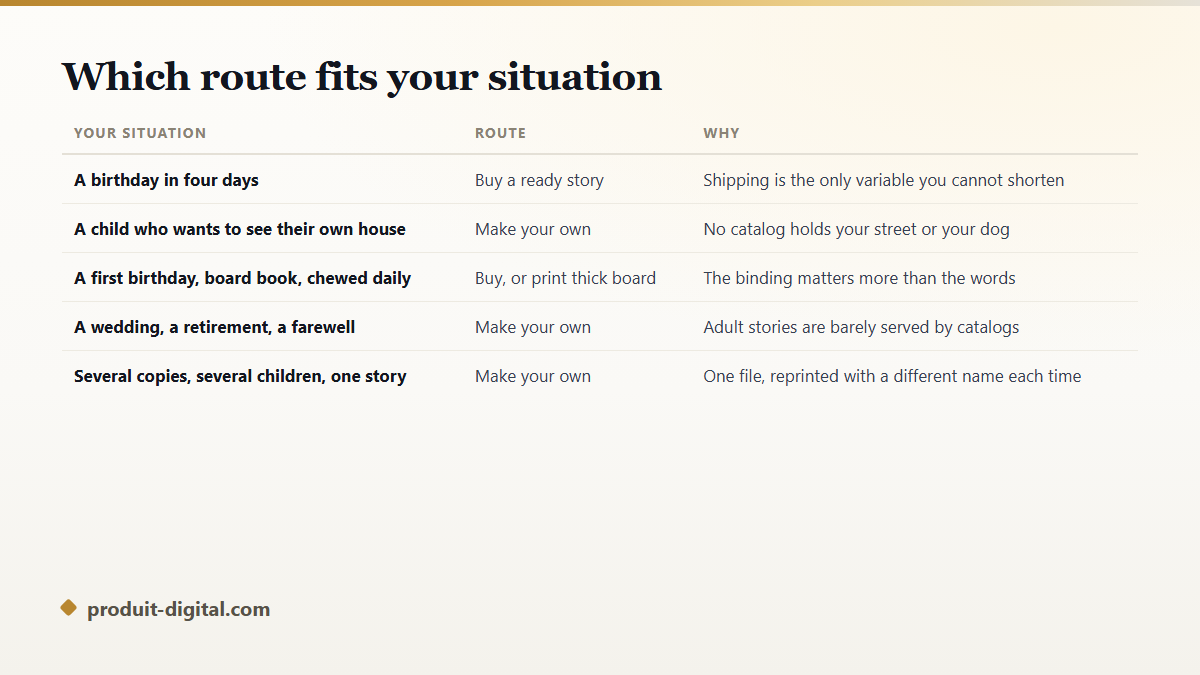
One case sits outside the table. If you want the same story for three siblings, making it once and reprinting with a different name each time costs one build and three print orders, which is the arrangement no shop offers.
Personalized books are not only for children
The adult side of this market is thinly served, which makes it the easiest place to give something nobody else will. A retirement book that walks through thirty years of a career, told by the people who were there. A wedding book about how the couple actually met, illustrated rather than photographed. A book for a parent collecting the stories the grandchildren keep asking to hear again.
The same mechanism explains why a family cookbook lands so hard as a present: a collection of recipes rewritten and printed for one household is a personalized book wearing an apron. The recipient finds their own life inside a properly printed object, and that is the effect, whatever the subject happens to be.
Writing a story that is more than a name swap
Start from a true event and exaggerate it. The afternoon a toddler decided the vacuum cleaner was an animal makes a better spine than any invented quest, because everyone in the family already knows the ending and will ask for it twice. Fiction built on a real memory keeps its details without any effort from you.
Keep the recipient active. In weak personalized stories the named child is carried along while events happen around them; in strong ones they decide something, get it wrong, and put it right. Keep the reading age honest as well: a three year old wants one sentence a page and a repeated line to say out loud, while a seven year old wants chapters and a joke the adults do not immediately catch.
Printing, binding and the object itself
The object matters as much as the words. Very young children need thick board pages, because a paper picture book handed to a one year old lasts about a week. That single constraint shapes the whole category of first books that open on a baby's own name, where the binding decision comes before the story decision.
For older children and for adults, a hardcover with a printed jacket reads as a real book rather than a printout, and print on demand services will produce a single copy on request. Check which trim sizes your printer offers before laying out the pages, add extra margin on the inside edge so the binding does not eat the text, and order one proof. Reading a proof out loud catches the line that does not scan, which no screen ever does.
Mistakes that spoil a personalized book
- A name inserted so often that it stops sounding like a name.
- Details from your memory rather than theirs, which turns the gift into a book about you.
- A face that changes between illustrations, breaking the recognition the whole book depends on.
- Text set too small for the reader's age, or too long for their patience.
- An inside joke on the cover, where a visitor should still understand what the book is.
- One copy printed and no file kept, so nothing can be replaced after a spilled drink.
The repetition problem deserves its own line. Read the draft out loud and count the name. Once per spread is plenty, and the story should still work if you replace it with a pronoun half the time. Overuse is what makes a custom book feel like a form letter with pictures.
Selling personalized books rather than giving them
There is a genuine business here, and it is not a passive one. Sellers who last build one strong story that accepts a name, an appearance and a dedication, then automate the swap and the print order. Their real work sits in setup and customer service, because a wrong name printed means a reprint, and delivery dates in December decide whether the year works out.
The other model is bespoke. You write each book for one buyer, charge accordingly, and take far fewer orders. It suits illustrators and writers who want the work to stay interesting, and it goes wrong whenever the maker underestimates how long a personal story takes to get right. Decide which of the two you are running before the first order arrives, because the tools, the volume and the promises are all different.
Frequently asked questions
Are personalized books worth it?
For a gift, usually yes, because the recipient cannot obtain the same object anywhere else and copies tend to be kept rather than passed on. The value drops sharply when the personalization is thin, meaning a name dropped into a story that would read exactly the same without it. Judge a title by how much of it would break if you removed the name.
What is the best age for a personalized book?
Between roughly two and eight the effect is strongest, because that is when a child is learning that their name belongs to them and is delighted to find it printed. Under two, the binding matters more than the text. Above eight, a name alone stops being enough and the story has to carry the book, which is when personalization shifts toward real events instead of a swapped word.
Can I make one if I cannot draw?
Yes. Photographs work well for books about real people and real events. Illustration tools produce artwork from a written description, and the thing to test before committing is whether the tool holds the same character across many images rather than inventing a new person each time. Twelve pages need twelve pictures of the same child, not twelve pictures of children.
How long does it take to make one?
An evening for a short picture book when the details are ready and the illustration is handled for you, a weekend for something longer or laid out by hand, and two to four weeks more if a printed copy has to arrive. Work backward from the date. Printing and shipping are the parts you cannot compress, so lock the file at least two weeks before the occasion.
Do I need permission to use someone's name or photograph?
For a private gift, no. For a book you sell, yes: publishing a recognizable person's image or name commercially requires their consent, and a parent's consent for a child. Get written permission before printing anything that leaves the family, and avoid school portraits, since the photographer usually holds the copyright rather than the family who bought the prints.
What is the difference between a custom book and a personalized book?
In everyday use the terms overlap, and custom books and personalized books both describe a title adapted to one buyer. Where a distinction is drawn, personalized tends to mean a fixed story with variable elements, while custom suggests the whole thing was made to order. Shops tend to use the first word and private makers the second, so read what the product actually changes rather than trusting the label.
Start with one person and ten details
Write down the name of the person, the occasion, and ten details only you would know. That list is the book, and everything after it is production. When you want the writing, the illustrations with a face that stays the same, the cover and the print-ready file produced in one place, see what the platform builds from a single idea and open an account to make the first version.