Etsy's digital section is the part of the marketplace where nothing ships. A file gets built once and sold a thousand times, which is why so many people looking for digital products to sell on Etsy end up staring at the same handful of categories. The listings that win there are rarely the prettiest ones.
They are the ones answering a task somebody already had, on a deadline somebody else set. A bride with a wedding in five weeks, a teacher with a unit to cover on Monday, a crafter with a machine and a blank sheet of vinyl. Knowing who sits on the other side of that search changes what you build.
The short answer: what sells on Etsy right now
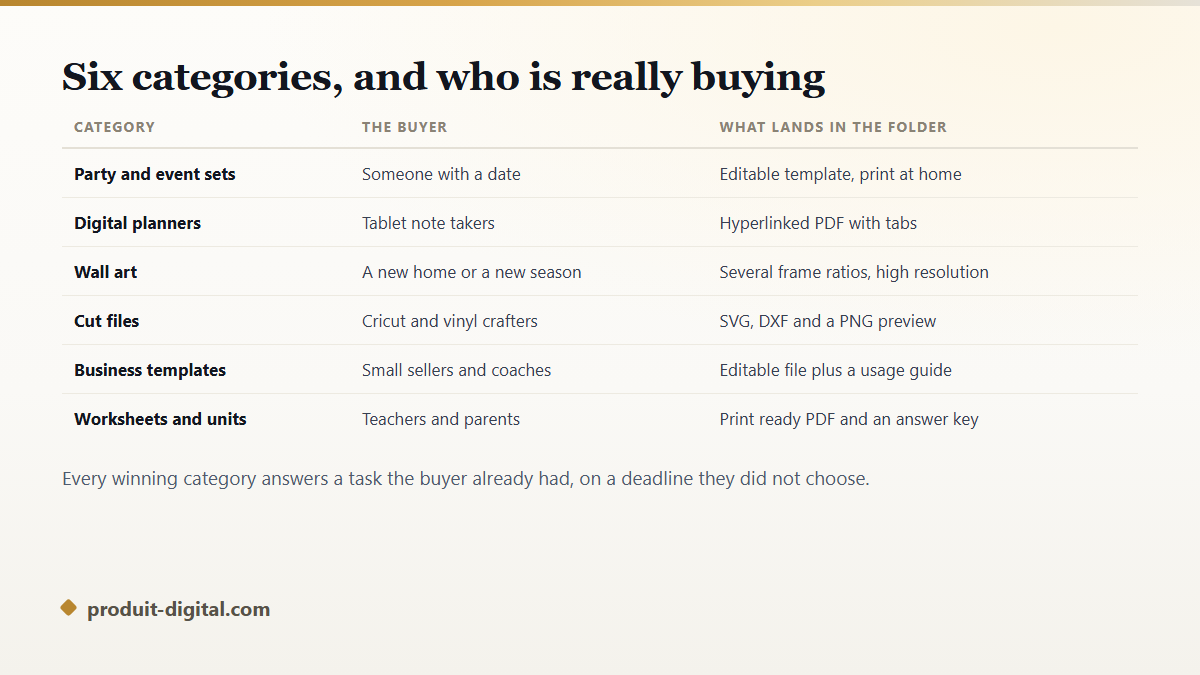
Party and event templates, digital planners, printable wall art, cut files for craft machines, business and social templates, and classroom worksheets. Those six carry most of the volume. Inside each one, the listings that hold their position are complete rather than clever: several sizes, an instructions page, a plain license, and a first image showing the product in use. Personalization sits on top of all of them, and that is where the margin has moved.
Digital products to sell on Etsy: the six categories that move
The six below are where sustained demand sits, and the reason repeats itself: a buyer with a task and a date. A closer survey of which listings hold the top of each category and what they have in common goes deeper on the individual niches. What follows is the map.
- Party and event sets: invitations, signage, games and thank you cards, sold as one folder for one occasion.
- Digital planners: hyperlinked PDFs built for a tablet, sold by the year and by the life situation.
- Printable wall art: offered in several frame ratios, because the buyer already owns the frame.
- Cut files: SVG and DXF for cutting machines, where technical correctness outranks the artwork.
- Business and social templates: editable sets for small sellers who need a look and have no designer.
- Worksheets and classroom units: matched to an age band and a subject, with an answer key included.
- Personalized keepsakes: name art, family portraits, custom story books, built per order rather than downloaded.
Two of those carry a warning. Cut files live or die on file structure, since a badly grouped SVG jams a machine and produces a refund request the same evening. Digital planners demand real maintenance, because a dated planner has to be rebuilt every year and buyers spot a recycled one immediately.
What digital products sell best on Etsy, and why
Read the pattern rather than the list. What digital products sell best on Etsy are the ones bought under time pressure, by somebody who would rather pay than learn a design tool. The alternative to your invitation set is not a competitor's invitation set. It is an evening the buyer does not have.
The second pattern is taste. Etsy shoppers are choosing a look, not commissioning a solution. A file matching one specific aesthetic sells better than a generic one that technically fits more occasions. Narrow beats broad here, which is the opposite of how most sellers build their first listing.
How Etsy delivers a digital order
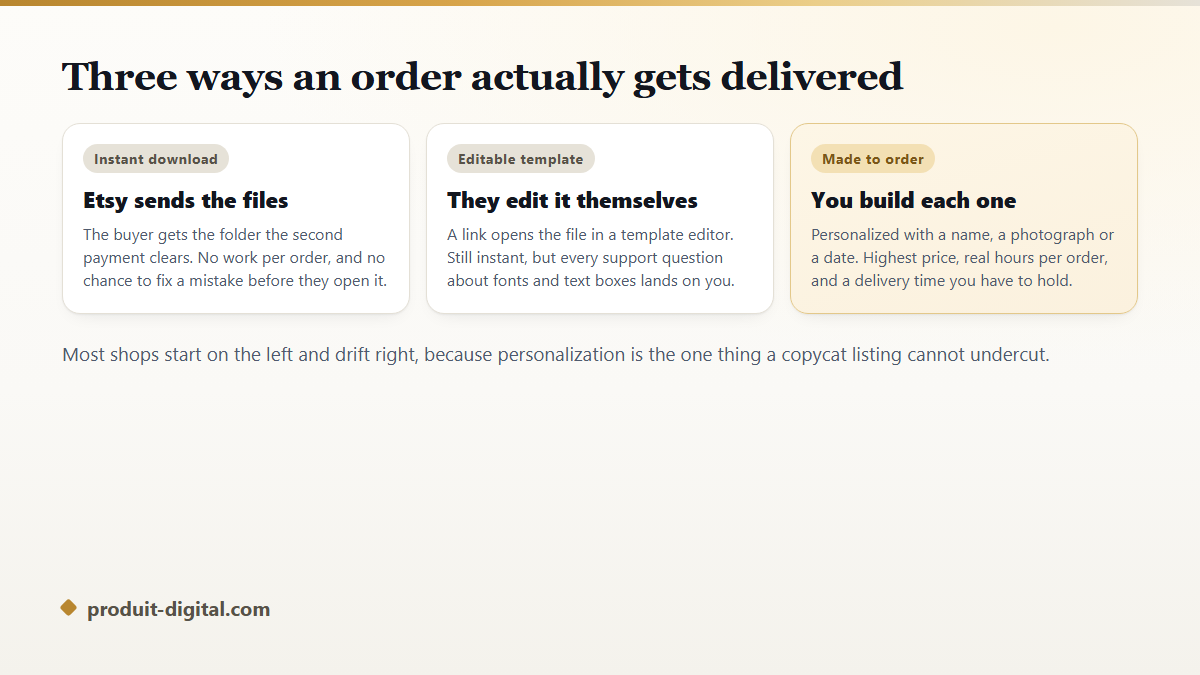
Three delivery modes exist and they demand very different amounts of your time. An instant download hands over the folder as soon as payment clears, with no work per order. An editable template sends the buyer into a template editor, still instant, but every question about fonts and text boxes comes back to you. A made to order listing means you build each one, which prices highest and costs real hours.
The mechanics have limits worth knowing before you plan the folder. According to Etsy's seller documentation, a digital listing carries up to five files, each capped at twenty megabytes, and a listing runs for four months before it renews. A kit bigger than that gets zipped into one archive, which works, and which also hands the buyer an extra step and an extra way to get lost.
Read the saturation before you build anything
Most lists of digital products to sell on Etsy stop at the category name, which is exactly where the useful work starts. Search your idea the way a buyer would, then read what comes back. Count how many results are recent, how many carry hundreds of reviews, and how many are the same file under a different cover. A page of identical thumbnails means the niche is being fought on price.
The signal worth chasing is a first page that only partly answers the query. That gap is a product. Amandine found hers by searching for a christening invitation set in a particular style, finding only generic ones, and building the specific version nobody had made.
Personalization is where the margin went
Instant downloads are the easiest thing on Etsy to copy. Someone buys yours, changes the colors and undercuts you by the weekend. Personalized products resist that, because the buyer is paying for something that did not exist before they ordered it.
The trade is your time. A name on a print takes two minutes. A custom story book carrying a child's name and face on every page takes real work, and it commands a price no template can. That model breaks at volume, which is the point where production has to be automated rather than done by hand.
Formats, and what "editable" really costs you
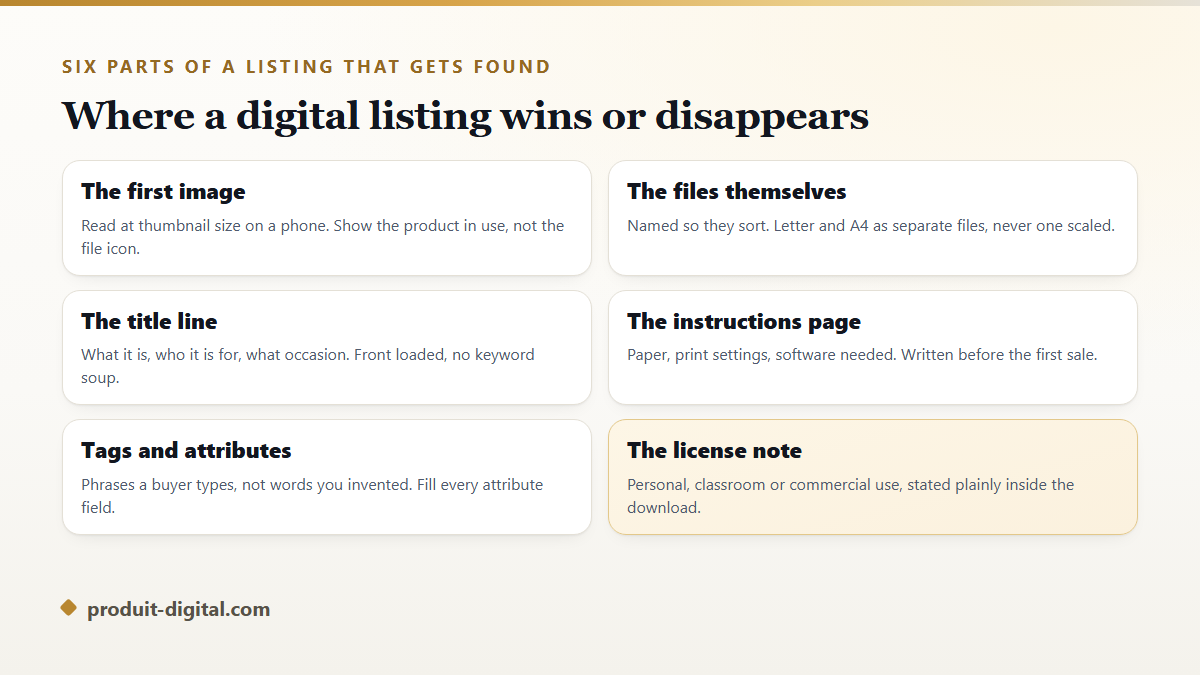
Match the format to the machine that opens it. PDF for anything printed, with Letter and A4 as separate files rather than one the buyer has to scale. SVG plus DXF for cutting machines. High resolution PNG or JPG for photo labs and social use. Native template files only where the buyer genuinely needs to change the text.
Editable listings sell well and carry a support cost most sellers underestimate. Every buyer who cannot find the text box, or whose font substituted itself, writes to you. Put a short walkthrough in the download and answer the same three questions before they get asked. That single page is worth more than any redesign.
The listing decides whether the file is ever found
Etsy gives a listing up to ten photographs, a title field of a hundred and forty characters, and thirteen tags. Most sellers waste all three. The first image is the entire decision on a phone screen, so it should show the product in use, legible at thumbnail size, rather than a picture of a file icon.
Write the title as a human sentence with the important words in front: what it is, who it is for, which occasion. Fill every attribute field Etsy offers, since those feed the filters buyers use to narrow a search. Then spend the thirteen tags on phrases people actually type, including the oddly specific ones.
Fees, margin, and the number that matters
Etsy charges a listing fee, a transaction fee on every sale, and a payment processing fee, with advertising on top if you choose it. None of it is negotiable, and all of it belongs in your arithmetic before you set a price. The honest version of that sum, including the hours nobody counts, is worked through in a breakdown of what a digital shop really keeps per sale.
The number that decides things is not the fee rate, it is what one product earns across its whole life. A template that keeps selling for two years with no further work absorbs its costs easily. A personalized order that eats an hour has to clear an hourly rate first, before any of it counts as income. Rank your listings by that measure and the ones to retire announce themselves.
Rights: what Etsy requires you to be able to say
Etsy's policies require that what you list be made or designed by you. Reselling a file bought with resale rights sits in a gray area that gets shops closed, and reselling one you simply found does not sit in a gray area at all. Keep your working files: they are the evidence if a listing is ever reported.
Check every ingredient too. Font licenses often separate personal use from products sold as files. Clip art licenses commonly forbid resale of the asset in editable form. And a design referencing a film, a team or a brand is an infringement claim waiting to arrive, however many similar listings survive today.
Reviews, refunds and the download problem
Sellers set their own return policy, and most digital shops state that downloads cannot be returned once delivered. That protects the file and does nothing for the review, so prevention carries the whole load: an instructions page, previews showing exactly what is included, and a fast reply when something will not open. Most one star reviews on digital products on Etsy come from confusion rather than quality.
Ask for the review at the right moment, which is after the buyer has used the file rather than the minute it lands. A short note inside the folder pointing at the instructions page, plus one message a few days later, moves a shop's rating further than any change to the artwork. Ratings compound, and the earliest ones shape how every listing you add afterward performs.
When one marketplace stops being enough
Etsy brings buyers you would never have found, and takes a cut and the customer relationship in exchange. That trade is excellent at the start and worsens as a shop grows, which is why established sellers usually keep marketplace listings for discovery and their own store for margin and email addresses.
The choice is a matter of stage rather than principle, and the comparison of which platform fits a shop at which point in its life is worth reading before building a store you are not yet ready to send traffic to.
The long products most Etsy shops never try
Almost everything above is short: a sheet, a set, a template. The categories with the least competition are the ones that take longer to produce. Illustrated children's books, workbooks with real teaching inside them, guides that solve a problem from one end to the other. They are hard to copy precisely because they are hard to make.
Production time was always the barrier, and that is the part that changed. Writing, illustrating, laying out and exporting a complete document in one run instead of four applications, through a build that carries a subject from outline to a finished illustrated file, brings a category within reach that most shops still skip. The whole route is mapped in the step by step path from an idea to a sellable digital file.
Frequently asked questions
What are the best digital products to sell on Etsy for a beginner?
Something you already know how to make, in a niche you can describe precisely. Party and event templates are the usual entry point, because demand renews constantly and one strong set adapts across occasions. Leave cut files and dated planners for later: the first carries technical traps, the second commits you to an annual rebuild.
How many listings do I need before anything sells?
More than a handful and fewer than people claim. A shop with three listings gives Etsy almost nothing to test, while dozens of weak ones blur what the shop is for. Twenty solid listings inside one coherent niche beats a hundred scattered across unrelated ideas.
Do I need to offer both Letter and A4?
Yes, for anything printed. Etsy is international, and asking a buyer to scale a file shifts every measurement on the page. Export both from the same layout, name them clearly, and the question stops being asked. It is the cheapest way to avoid a print sizing complaint.
Can I sell the same digital products on Etsy and elsewhere?
Yes, unless you signed an exclusivity agreement with somebody. Most sellers list in several places and keep one master file, exporting per platform. Two diverging versions of the same product is how outdated files reach buyers, so edit the master and export again rather than patching each copy.
How do I stop people reselling my files?
You cannot stop it completely, and building a shop around that fear wastes energy. Put the license terms inside the download, register the work where its value justifies the paperwork, and use the marketplace reporting tools when you find a copy. Then spend the remaining hours on the next product.
Is it too late to start selling digital products on Etsy?
The generic categories are crowded and were already crowded five years ago. The specific ones are not. A search returning partial matches is still an opening, and personalization and longer form products stay thinly served because they take work. Late applies to the easy ideas, not to the market.
Pick one occasion and build the whole folder
Choose a single occasion you understand, build the complete set for it rather than one sheet, and list it with an instructions page and honest previews. That is a weekend, and it teaches more than a month of research. To see the writing, the illustrations, the layout and the export coming out of one place, look at what the platform produces from end to end and open an account to build the first product.