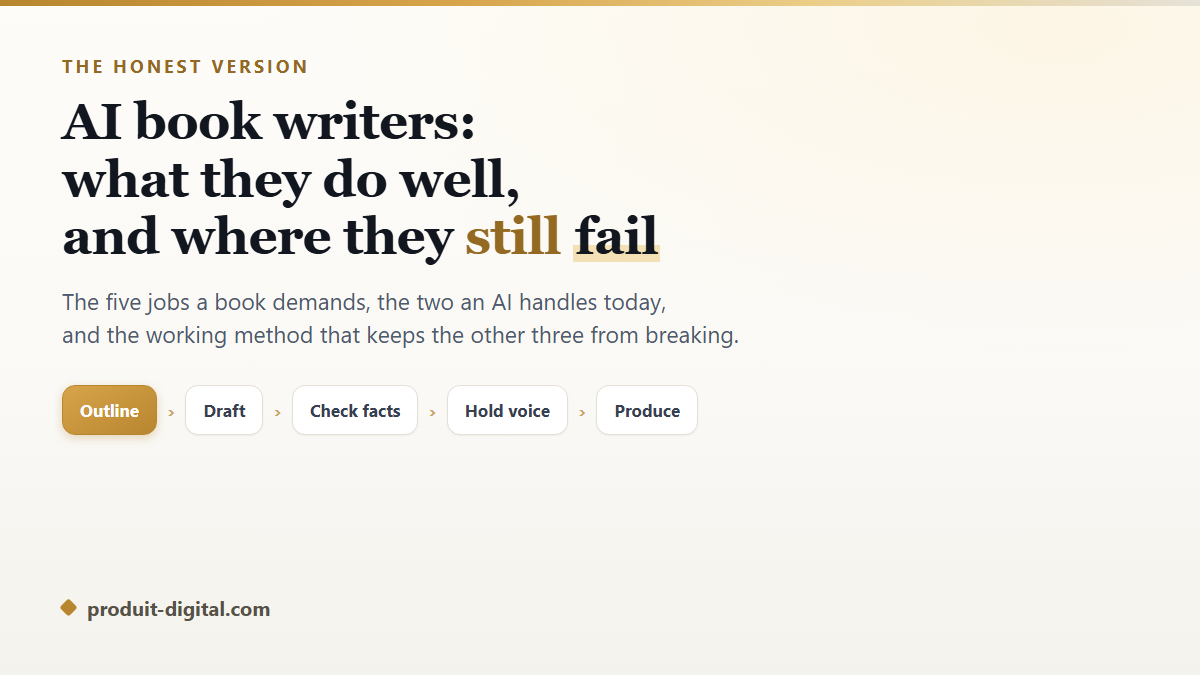
An ai book writer will hand you thirty clean pages before your coffee goes cold. That part is real, and it is why the category grew so fast. The disappointment arrives later, usually around chapter seven, when the main character has changed jobs, two chapters argue the same point with different examples, and a paragraph cites a study that turns out not to exist. The pages were never the hard part of writing a book.
This article separates what these tools do genuinely well from what they still get wrong, and gives you the working method that makes the difference. No tool is named as a savior and none is dismissed. If you want the manual version of the same journey, the complete path from first idea to final page covers what a book demands before any software enters the picture.
The short answer
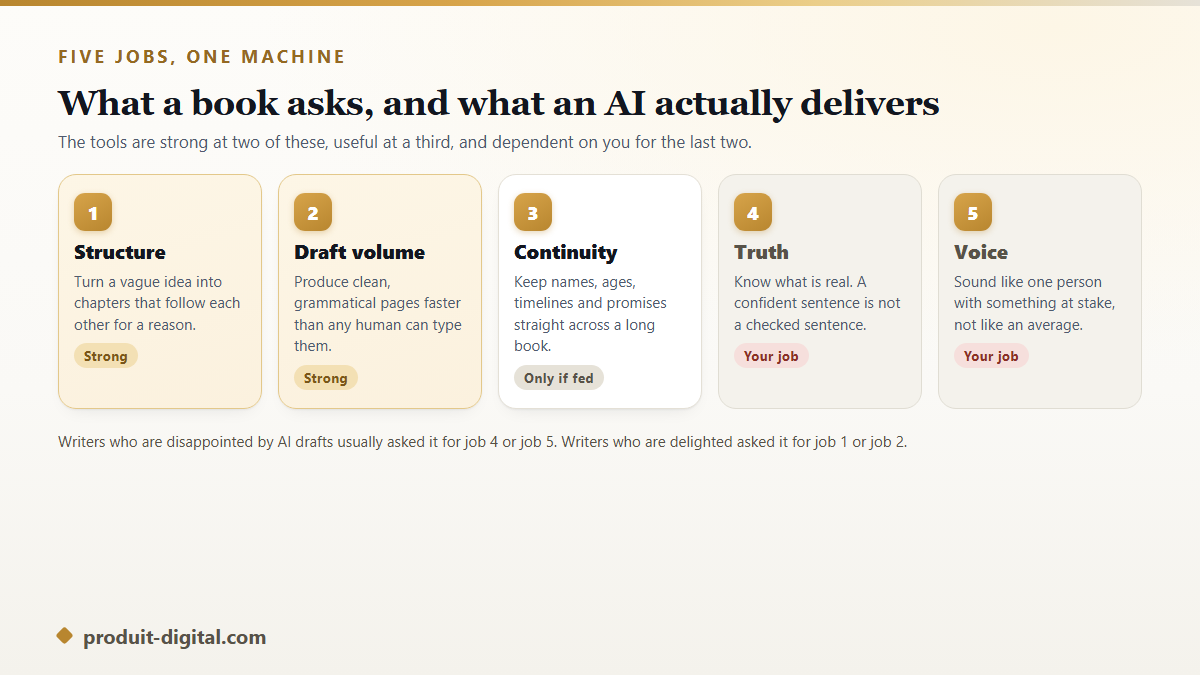
An AI book writer is excellent at two jobs and dependent on you for three. It turns a vague idea into a structure that holds, and it produces clean draft pages at a speed no human matches. It cannot verify a fact, it cannot invent a voice that sounds like a person with something at stake, and it will not remember chapter two when it writes chapter eleven unless something forces it to. Give it a plan you approved and a written record of your book's facts, and the draft becomes worth editing. Give it a paragraph and a hope, and you get filler.
What an AI book writer actually is
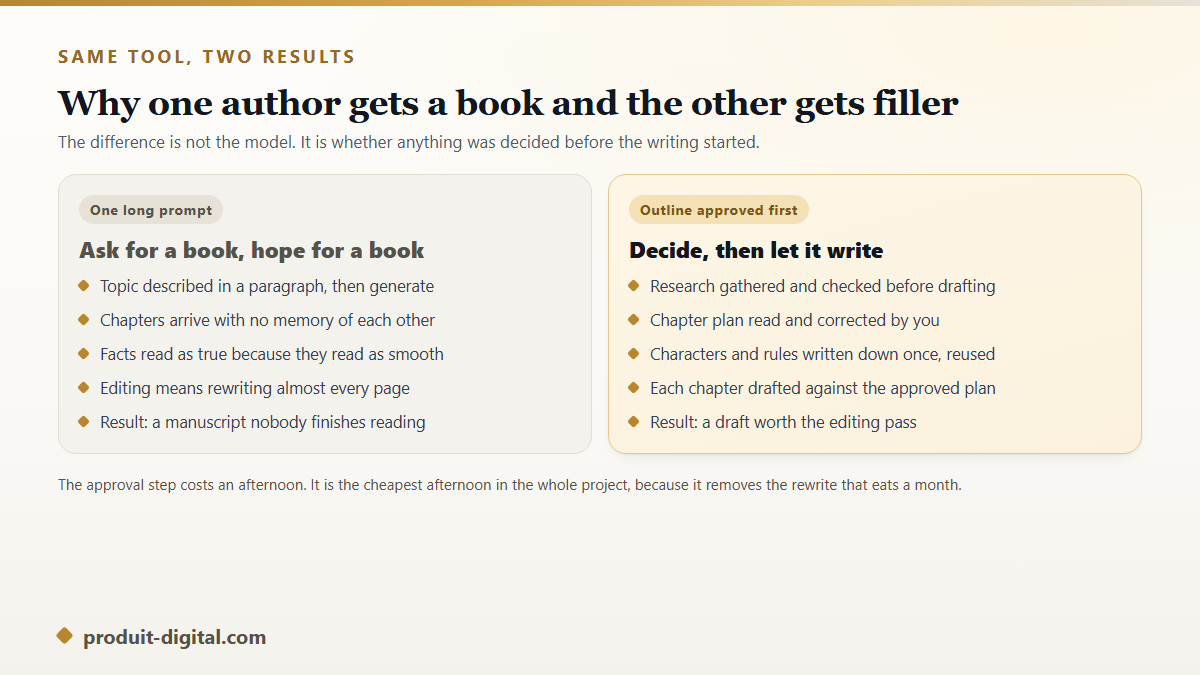
Strip away the marketing and these tools are all built the same way. A language model predicts text, and a layer around it decides what to send, in what order, and with what context attached. That layer is the whole product. Two services running the same underlying model produce very different books, because one sends the model your approved outline, your character sheet and the previous chapter, while the other sends a topic and a word count.
The consequence is practical. Judge a tool by what it remembers and what it asks you before writing, not by the quality of the sample paragraph on its home page. A single paragraph is the easiest thing in the world for a model to do well. Forty thousand words that agree with each other is the test that separates the category, and no demo ever shows it.
The two jobs it genuinely does better than you
Structure is the first. Most abandoned books die from a plan that never existed, and a model that has absorbed the shape of thousands of books is unusually good at proposing chapters that follow each other for a reason. You will change half of what it suggests, but arguing with a bad plan is far easier than facing a blank page. Draft volume is the second. A model produces grammatical, orderly prose faster than you can type, and a rough page you can cut is worth more than a perfect page you never wrote.
- Turning notes into an outline. Twenty scattered ideas become a chapter order you can argue with in minutes.
- Breaking a wall. A chapter that has been stuck for a week gets three possible openings and you pick the one you hate least.
- Rewriting at length. A section you already wrote can be shortened, expanded or reordered without you retyping it.
- Translating your own book. A finished manuscript moves into another language in hours, ready for a native reader to correct.
- Handling the dull furniture. Chapter summaries, back cover text and a table of contents are exactly the kind of writing nobody wants to do twice.
Four kinds of tool you will meet
The category name covers products that do very different amounts of the work, which is why two honest reviews of the same tool can contradict each other. Knowing which of the four you are looking at settles most arguments before they start.
- General chat assistants. Free or inexpensive, very good on a single chapter, with no memory of your book between sessions. Fine for a short guide, punishing over a novel.
- Writing apps with AI added. Your usual editor gains suggestions and rewriting. The manuscript stays in your document, which keeps you in control and leaves the structure entirely to you.
- Book generators. You describe a book and the tool returns a whole manuscript. Fast, and the result depends completely on whether an outline was approved before drafting began.
- Production platforms. Writing, illustration, cover and the publishable file in one chain, with the book's facts carried from each step into the next. More setup, far less repair afterward.
Where book writing AI still fails
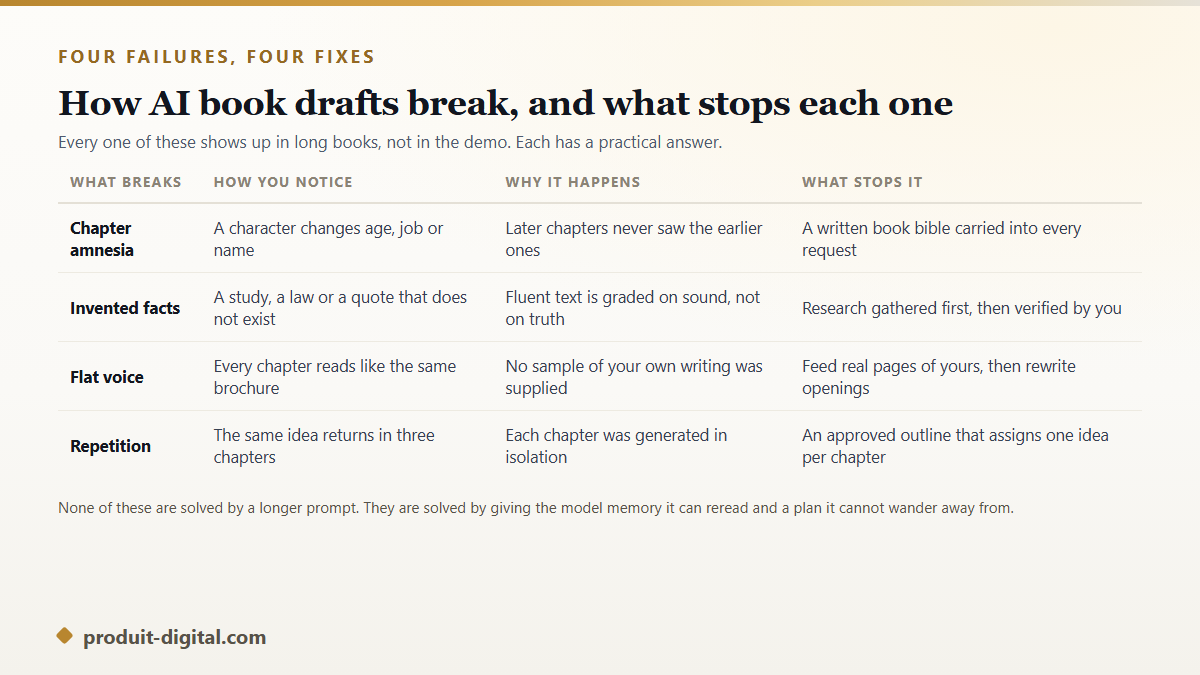
Fluent text is graded by the model on how well it sounds, not on whether it is true. That single fact explains most of the damage. A model asked for a nonfiction chapter will produce a study, a percentage and an author name in the same confident tone as everything around them, and the invented ones look exactly like the real ones. Any book that makes factual claims needs a human who checks every claim, and there is no version of book writing ai that removes that step.
Memory is the second failure. A long book exceeds what a model can hold at once, so late chapters are written by something that never read the early ones. Names drift, ages change, a promise made in chapter three is never paid off. The third failure is voice. Left alone, a model writes toward the middle of everything it has seen, which produces prose that is correct, smooth and completely anonymous. Readers cannot name what is wrong, but they stop reading.
Why the failures happen, and what actually fixes them
Every one of these problems has the same root: the model is being asked to hold in its head what should have been written down. The fix is unglamorous. Before drafting, you produce a short document that names your characters, their ages, their relationships and the rules of your world, or for nonfiction the sources you accept, the terms you use and the position you argue. That document travels with every request. It is the difference between a collaborator with notes and a stranger who arrived this morning.
The second fix is the approved plan. When the chapter order is fixed and each chapter has one assigned job, the model cannot repeat itself, because chapter nine is not allowed to make chapter four's point. Tools that ask you to sign off on an outline before writing a word are not adding a bureaucratic step. They are removing the two failures that ruin the most manuscripts, which is why the outline you approve before anything is written sits at the front of the Produit Digital workflow.
The method that separates a draft from filler
Amandine writes practical guides in her field. Her first attempt with an AI tool produced sixty pages she deleted. Her second produced a book she published, using the same software. The method below is what changed between the two, and it costs about an afternoon before any drafting starts.
- Decide the reader and the promise. One sentence naming who the book is for and what changes for them by the last page. Everything else is judged against it.
- Gather the material first. Sources, interviews, your own notes and anything the book asserts. Research before drafting, not after, so the model quotes real things.
- Approve the outline yourself. Read the proposed chapters, cut two, merge two, and reorder until the argument moves. Do not draft before this feels right.
- Write the book bible. Names, ages, places, timeline, recurring terms. One page. It goes into every chapter request from now on.
- Draft chapter by chapter. One chapter at a time, with the outline and the bible attached, and the previous chapter's ending in view.
- Rewrite the openings and endings by hand. The first and last paragraph of each chapter carry the voice. These are the pages readers judge you on.
- Check every factual claim. Name, date, figure, quotation. If you cannot confirm it, it comes out of the book.
AI book writing for fiction and for nonfiction
The two cases fail differently and need different care. Nonfiction breaks on truth: every claim is a risk, and a chapter of confident, wrong information does more harm to your reputation than a chapter you never published. Nonfiction also benefits most from structure, because the reader wants an argument that builds, and that is exactly what a model proposes well.
Fiction breaks on continuity and on voice. A reader forgives a slow chapter and never forgives a character who forgets her own brother's name. The tools that handle novels carry a character record and the story so far into every scene, which is the specific problem covered in the article on keeping characters and plot coherent across a long story. For fiction, expect to rewrite more of the prose yourself, because voice is most of what a novel is.
Illustrated books are the hardest test
A children's book or an illustrated guide adds a failure the text-only tools never face. Generate twelve pictures from twelve descriptions and you get twelve different children, because each image is produced without knowledge of the last. A parent notices on the first read. Most disappointing illustrated projects die exactly here, after the words were finished.
Solving it requires the picture side to carry a reference of the character forward, page after page, in the same way the text side carries a book bible. That is the reason Produit Digital treats writing, illustration, cover and layout as one chain rather than four unconnected tools, and why the final PDF comes out of the same place the first sentence did.
What AI for book writing does to your voice
This is the objection worth taking seriously. A model writes toward an average, and an author who accepts the first draft publishes that average. The result is legible, polite and forgettable, and readers who cannot explain why they stopped are still gone. Using ai for book writing without losing yourself takes a deliberate habit rather than a setting.
Feed it your own pages. Three or four samples of writing you are proud of, supplied as a reference, move the output measurably closer to how you sound. Then rewrite by hand the parts that carry personality: the opening of every chapter, the last line, the anecdotes, the jokes and anything you feel strongly about. The practical technique is covered further in the guide on writing with AI without producing text that sounds like it.
The rules you cannot outsource
Platform rules are explicit and worth knowing before you publish. According to Amazon KDP's content guidelines, you are required to tell Amazon at upload whether the text, the images or the translation of your book are AI-generated, and Amazon also limits how many new titles an account may submit in a single day. Those rules exist because of the flood of unedited generated books, and they are enforced on accounts, not on files.
Copyright is the second point. The US Copyright Office states that material produced by a machine without sufficient human authorship is not protected, while a work containing meaningful human contribution can be registered with the machine-generated parts disclaimed. In plain terms, the more of the book is genuinely yours, the more of it you own. That is an argument for editing hard, not for hiding the tool.
How to judge an AI book writer before you trust it
Ignore the sample paragraph and test the things that break at length. Any tool can be evaluated in an hour with the checklist below, and the answers are usually visible before you pay for anything.
- Does it show you a plan first? A tool that starts writing immediately has no mechanism for keeping chapters distinct.
- Can you edit that plan? Approval that changes nothing is decoration.
- Does it keep a record of characters, terms or sources? Ask where that record lives and whether you can correct it.
- Can you regenerate one chapter without losing the rest? Book work is repair work, and repair is the daily reality.
- What comes out at the end? A file you own and can publish, or text stuck inside somebody's dashboard.
- Does it research before it writes? For nonfiction, a tool that gathers material first invents far less.
What it honestly costs you in time
The claim that a book takes an afternoon is the reason so many people are disappointed. A realistic account for a nonfiction book of ordinary length looks like this: an afternoon on the reader, the promise and the research, a few hours settling the outline, a couple of days of drafting sessions, then a solid week of editing, fact-checking and rewriting the parts that carry your voice. That is a fraction of the traditional timeline and nothing like a single click.
The saving is real and it lands in a specific place. What disappears is the drudgery: the blank page, the retyping, the reordering, the chapter summaries. What remains is judgment, and judgment is the part readers are paying for. Anyone selling you a book with no editing pass is selling you the thing Amazon's rules were written to catch.
Frequently asked questions
Can I legally sell a book written with AI?
Yes, on the major platforms, provided you follow their disclosure rules. Amazon KDP asks you to declare AI-generated content at upload. Copyright protection is a separate question: the US Copyright Office protects the human contribution rather than the machine output, so heavy editing is in your interest twice over.
Will readers be able to tell?
They can tell when nothing was edited. Unrevised generated prose has a recognizable evenness, no strong opinions and no specific detail. A draft that has been cut, argued with and rewritten in the places that matter reads as yours, because by then most of what readers notice is.
Which is better for a novel, and which for nonfiction?
Nonfiction gains more, because structure and research are where the tools are strongest and where writers waste the most time. Fiction gains less on the sentence level and a great deal on continuity, provided the tool tracks characters and plot rather than generating scenes in isolation.
Do I need to be a writer already?
You need to be a reader and a judge. The skill that matters is recognizing when a chapter is boring, when a claim smells wrong and when a sentence does not sound like you. Producing the raw text is the part you can now delegate.
How is this different from a general chat assistant?
A general assistant answers requests one at a time and forgets the book between them. A tool built for books carries the outline, the character record and the previous chapters into every request, then produces the cover, the illustrations and the publishable file at the end. That difference is examined tool by tool in the comparison of book generators beyond the demo effect.
An AI book writer earns its place the moment you stop asking it to be the author and start using it as the fastest first-draft machine ever built, with you holding the plan, the facts and the voice. If you want that chain in one place, from the outline you approve to a finished file you own, you can set up your first book project now or look at how the whole production chain fits together before you decide.