Almost nobody looks up how to write a book on a morning when they have nothing to say. You look it up because the idea has been sitting in your head for months, and because every attempt so far has gone the same way: four hundred good words, a reread, a wince, and a closed file. The obstacle is rarely talent. A book is simply a long project with no manager, no deadline, and no obvious next task once the first burst of excitement burns off.
This guide walks the whole path in the order a real book gets made. One promise, one shape, one outline, a drafting schedule you can actually keep, then revision split into separate passes, then the production work that turns a manuscript into something a reader can hold or download. Each stage ends with a concrete output. If you cannot point at the output, the stage is not finished, and moving on will cost you months later.
How do you write a book? The short answer
You write a book by breaking one large, vague ambition into a stack of small, boring tasks that have deadlines. Decide who the reader is and what changes for them. Split that promise into chapters, each with a job. Draft to a daily word count you could hit on a bad day. Then revise in passes, one problem at a time, and leave sentence polish until the structure holds. Writers who finish are not faster than the ones who quit. They just always know what today's task is.
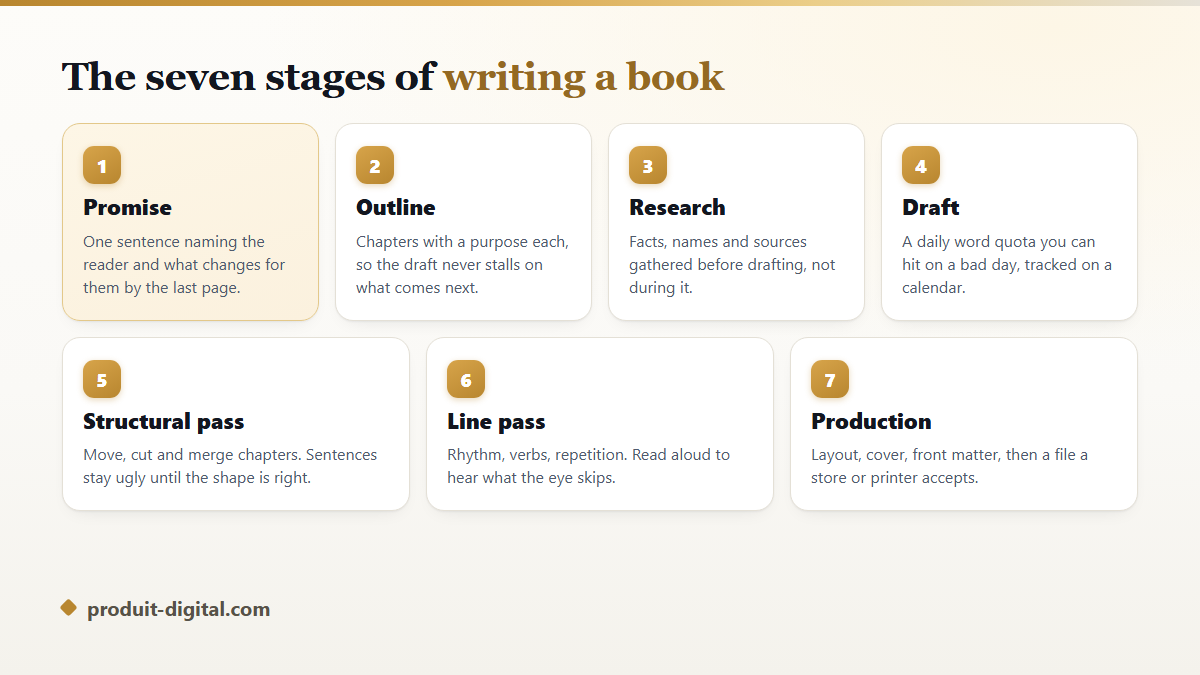
- Promise: one sentence naming the reader and what they get by the last page.
- Shape: the genre, the length, and the number of chapters, chosen before drafting.
- Outline: every chapter with a job, an opening image, a turn, and a target length.
- Research: facts, names, and sources gathered in one place, before you need them.
- Draft: a daily quota, tracked on a calendar, protected from editing.
- Revision: structure first, then scenes, then lines, then proofreading.
- Production: layout, cover, front matter, and a file that stores and printers accept.
Two of those stages carry most of the risk. The outline is where a book is quietly saved or lost, which is why it gets its own guide on building a chapter plan that survives contact with a real draft. Revision is where finished drafts stall, because writers try to fix every problem in a single read. Everything else on the list is closer to logistics than to art, and logistics can be scheduled.
Stage one: write the promise, not the premise
A premise is what the book is about. A promise is what the reader carries out of it. "A novel about a woman who inherits a bakery" is a premise, and it tells you nothing about what to cut. "A reader who has just lost a parent spends four hours with someone who turns grief into work, and closes the book feeling less alone" is a promise. The second version can settle an argument with yourself at eleven at night.
Write your promise on one line, at the top of the file, and look at it every time you hesitate. Julien spent two years on a business book that kept growing sideways. He finished it in five more months after he wrote "a freelancer in their first year stops underpricing" above chapter one and deleted three chapters that were serving a different reader entirely.
The promise also decides your title, your cover, your category, and the first line of your sales page. Books that never find readers usually went wrong here, long before anyone judged the prose.
Stage two: pick the shape, because length sets the calendar
Before writing a book you need a rough idea of how big it is. Length is not a matter of ambition. It is a shared expectation among agents, stores, and readers, and breaking it without a reason costs you sales. A picture book that runs four thousand words will not be read aloud at bedtime. An adult novel that stops at thirty thousand words reads as an unfinished draft, whatever its quality.
The usual ranges are wide but real. Picture books sit between five hundred and one thousand words. Middle grade novels run thirty thousand to fifty five thousand. Adult novels cluster between seventy thousand and one hundred thousand, with fantasy running longer and thrillers running shorter. Practical guides work from twenty thousand words up, and readers of nonfiction forgive shortness far more easily than padding.
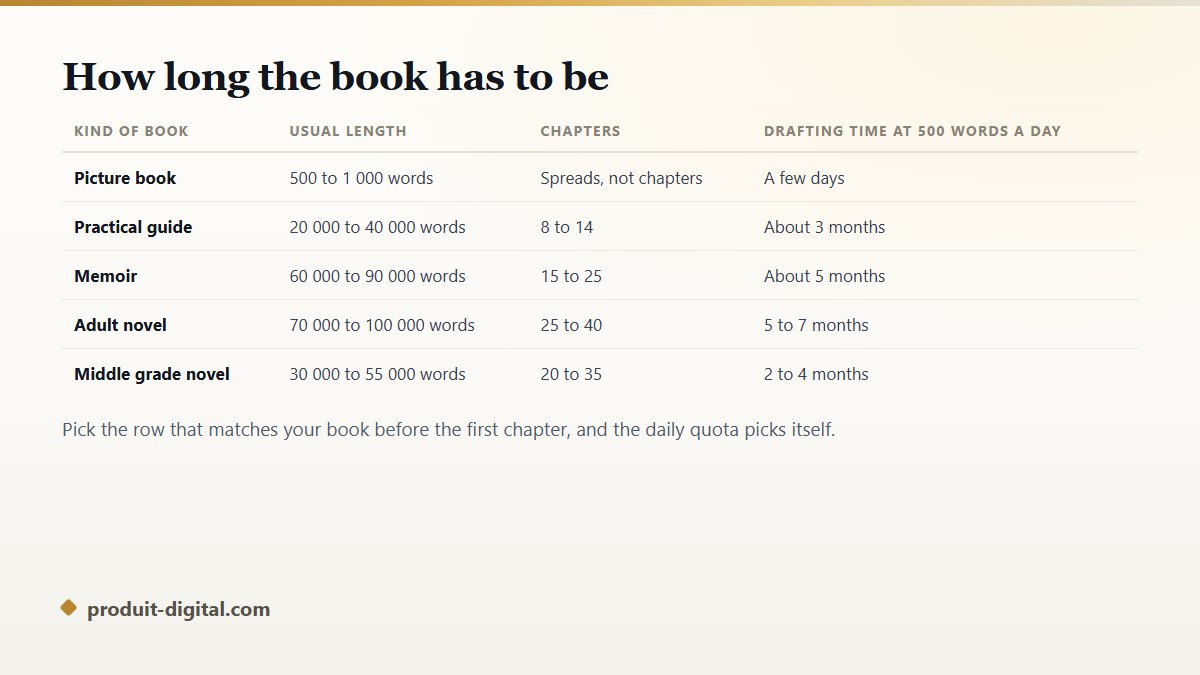
Once the range is chosen, the schedule writes itself. At five hundred words on weekdays only, eighty thousand words takes about eight months. At a thousand words a day including weekends, it takes under three. Neither number is virtuous. The one you keep is the right one. If you are heading into fiction, the beginner path through a first novel covers genre expectations and chapter rhythm in more detail.
Stage three: an outline with a job for every chapter
The clearest difference between books that get finished and books that die at chapter six is whether the writer knew what chapter seven was for. An outline is not a straitjacket. It is a note from the version of you who had energy to the version of you who sits down tired on a Tuesday and needs to start in ninety seconds.
Five short lines per chapter are enough. What is this chapter's job, in the reader's experience. What image or question opens it. What turns partway through, so the chapter is not a flat report. Where it lands. Roughly how many words it needs. A chapter row with those five lines can be drafted out of order, which matters enormously on the days when you cannot face the next scene but could happily write the argument in chapter fourteen.
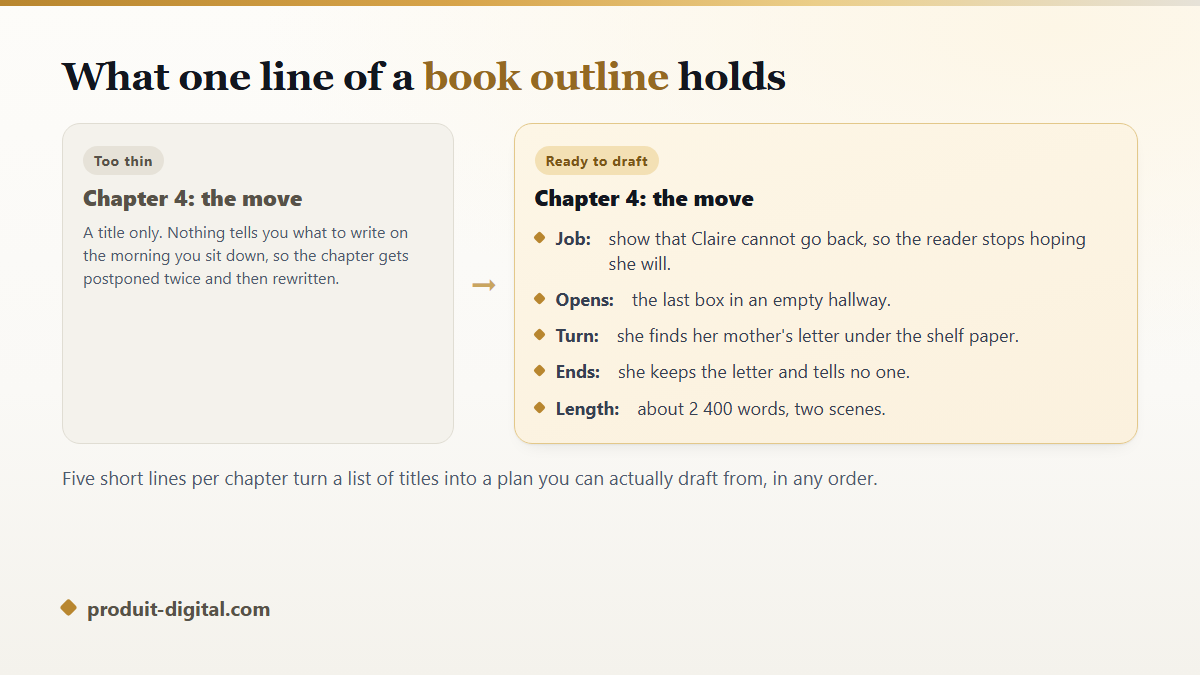
Outlines change, and that is a feature. What matters is that a change is deliberate. If chapter nine turns out to belong at the front, you move a row and see immediately which chapters now repeat themselves. Discovering the same thing after eighty thousand words means rewriting half the book. Working with an assistant makes this stage safer when the plan is approved before a single chapter is written, because a weak structure gets caught while changing it still costs nothing.
Stage four: research once, in one place
Research is the most respectable way to avoid writing. Left loose, it will eat a year. Give it a container: a single document with a heading per chapter, filled before drafting starts and closed once drafting does. Names, dates, technical details, the way a hospital ward smells at four in the morning, the exact wording of a rule you plan to cite.
While drafting, never stop to look something up. Type a marker such as [CHECK] and keep going. Fixing forty markers in one sitting takes an afternoon. Forty interruptions cost you forty restarts, and a restart is where most writing days die. Amandine, who writes historical fiction, keeps a file of markers per chapter and clears them on Fridays. She drafts on the other four days without ever opening a browser.
Stage five: a quota you can hit on your worst day
Motivation is a poor building material. A quota is better, and the correct quota is embarrassingly small. Three hundred words is roughly one page. On a good day you will write far more, and nobody will stop you. On a bad day you will still finish, and the streak survives, which is the entire point.
Track it somewhere visible. A paper calendar with a cross per day works as well as any app. Two rules make it hold: no zero days without a planned rest day, and no editing yesterday's words before today's quota is done. That second rule feels wrong and saves more books than any writing course.
How to write a book while holding a full time job
Most first books are written by people with jobs, children, or both. The constraint changes the plan in three ways. The quota drops to what fits your worst weekday, usually two hundred and fifty to four hundred words. The outline becomes non negotiable, because you cannot afford to spend a rare free hour deciding what to write. And you protect one slot in the week, ideally the same one, for the tasks that need a longer runway: revision passes, research sweeps, or a chapter that will not open.
Writing on a phone during a commute counts. Dictating a scene while walking counts. What does not survive a busy life is a plan that depends on inspiration arriving at a convenient hour. Claire drafted a memoir in fourteen months at three hundred words each weekday morning before her children woke, and she never once wrote for more than forty minutes at a stretch.
Stage six: the first draft is allowed to be bad
The first draft exists to find out what the book is. Its only job is to reach the end. Weak dialogue, placeholder names, a chapter that is really just a summary of a chapter: all acceptable. You cannot revise a page that does not exist, and you cannot judge chapter two until chapter twenty exists to be compared with it.
Two habits protect a draft. Stop mid scene rather than at a clean break, so tomorrow starts with a task instead of a decision. And when a section refuses to work, write a bracketed note describing what should happen there, then move on. That bracket is a real decision, recorded. Staring at the same paragraph for three days is not.
Stage seven: revise in passes, in this order
The instinct is to open page one and fix everything at once. That is why revision stalls: you are trying to hold structure, character, rhythm, and commas in your head simultaneously. Split the work. Each pass has one question, and you answer only that question.
- Structural pass: does every chapter earn its place, and is the order right? Move, merge, and cut whole chapters. Expect to lose ten to twenty percent.
- Scene pass: does each chapter open late, turn once, and end with a reason to continue? Fix beginnings and endings, leave the middles alone.
- Line pass: read aloud. Cut the third adjective, replace weak verbs, break up any sentence you run out of breath on.
- Consistency pass: names, ages, eye colors, timeline, the spelling of every invented word. Keep a running sheet.
- Proofreading pass: on paper or in a different font, at least a week after the line pass, ideally by someone who is not you.
Leave at least two weeks between the finished draft and the structural pass. Distance is the only editing tool that works on your own prose. Writers who skip that gap almost always defend passages they would have cut a fortnight later.
Readers come before polish, not after
Send the book out after the structural pass, not after the proofread. Four to six readers is plenty, and the useful ones are people who read your genre for pleasure and owe you no kindness. Give them three questions: where did you get bored, where were you confused, and where did you stop believing it. Vague praise is pleasant and tells you nothing.
Weigh what they say by pattern, not volume. One reader disliking your ending is taste. Four readers slowing down in the same chapter is a structural fact, even if all four propose different fixes. Readers are reliable about where a problem is and unreliable about what the solution should be.
Turning a manuscript into an actual book
A finished manuscript is not yet a book. It needs a title page, a copyright page, a table of contents, page numbers that restart correctly, chapter openings that fall on the right side, and margins wide enough that the inner edge does not vanish into the spine. Printers reject files for gutter margins far more often than for anything artistic.
You also need a cover that survives being shown as a thumbnail the size of a stamp, and a file in the format your channel expects. According to Amazon KDP's documentation, a Kindle ebook is assigned an ASIN and needs no ISBN, while a paperback requires one and can use a free identifier supplied by the platform. The ISBN standard treats each format as a separate product, so a paperback, a hardcover, and an ebook each carry their own number. If you would rather not learn typesetting, an assisted route can hand you a laid out file that is already print ready from the chapters you approved.
Where AI helps with writing a book, and where it gets in the way
Used carelessly, a language model writes competent, weightless prose that readers abandon by chapter three. Used well, it removes the friction that actually stops books: the blank page, the flat outline, the chapter you have rewritten four times, the layout you do not want to learn. The rule that holds is simple. You keep every decision about meaning. The machine handles volume, structure suggestions, and production.
That is the shape of our own tool: you approve the outline first, then chapters are drafted against it, and you rewrite anything that does not sound like you. Illustrations keep the same character from page to page, and the finished book comes out as a file you can sell or print. If you want to see the whole chain in one place, the end to end book building workspace shows what each step produces. The honest limit: nothing generated will carry your particular way of seeing a thing until you put it there.
Three routes to a finished book
There is no single correct route, only trade offs between time, control, and money. Pick by which resource you have the most of.
- Write it alone with free tools. Total control, no cost beyond your time, and everything from outlining to layout is on you. Best if you enjoy the craft of production or have a long runway.
- Hire the gaps. A developmental editor, a cover designer, and a typesetter, hired separately. Fastest route to a professional object, and the most expensive. Best if the book has a business behind it.
- Use an assisted workspace. The plan, the drafting, the illustrations, and the layout live in one place, and you approve each step. Fastest route to a finished file, and the quality depends entirely on how hard you push back on the draft. A free tier lets you test the fit before committing anything.
Whichever route you take, the promise, the outline, and the revision passes stay yours. No tool and no freelancer can decide what your book is for. You can browse the rest of the method on our home page for authors if you want to see how the stages connect.
Decide where the book will live before you finish it
The destination changes the work, so choose it around the halfway point rather than the day you type the last line. A book meant for a print store needs a trim size, a spine width that depends on page count and paper, and a cover built as a single wrap. A book meant to be read on phones needs reflowable text and almost no fixed layout. A book sold directly from your own page can stay a fixed layout file and can carry full bleed illustrations that print channels would charge you for.
Knowing this early prevents the most expensive kind of rework. Illustrations commissioned at the wrong ratio have to be redone. A manuscript written in five hundred word sections reads well on a phone and looks choppy in print. Ten minutes of decision at the midpoint saves a fortnight at the end, and it also tells you what your cover has to compete against on the shelf or on the screen.
Five mistakes that cost first time authors the most months
- Editing chapter one for six months. It is the chapter you will understand last, so draft it roughly and come back after the ending exists.
- Choosing a length after drafting. A novel discovered to be twenty thousand words too short needs new structure, not new scenes.
- Researching without a closing date. Set the container, fill it, close it, draft.
- Showing the book to family first. Their job is to love you, which makes their feedback unusable for structural decisions.
- Treating layout as an afterthought. Formatting decisions made at the end, in a hurry, are why good manuscripts get returned by printers.
Frequently asked questions
How long does it take to write a book?
For a first book of about eighty thousand words, four months to two years is the normal range, and the spread comes from consistency rather than speed. Five hundred words on weekdays reaches eighty thousand in roughly eight months of drafting, plus two to four months of revision. Shorter books move faster: a practical guide of twenty five thousand words is a realistic three month project alongside a job.
Do I need an outline, or can I discover the story as I go?
Both approaches produce finished books, but they cost differently. Discovery drafting front loads the pleasure and back loads the work, since the structural problems all arrive at once during revision. Outlining front loads the difficulty into a week that feels unproductive. If you have never finished a long project, outline. You can always break the plan on purpose later.
How many words should a chapter be?
Between fifteen hundred and four thousand words in most adult fiction, and shorter in thrillers and in children's books. Consistency matters more than the number, because readers learn your rhythm within three chapters and feel it when a chapter runs long. If a chapter passes six thousand words, it is usually two chapters that have not been separated yet.
Can I write a book without being a good writer?
Yes, if the book has a clear promise and a structure that delivers it. Readers forgive plain sentences far more easily than a book that wastes their time or does not deliver what the cover offered. Nonfiction especially rewards clarity over style. Sentence quality also improves faster than most people expect once you read your drafts aloud and cut anything that trips you.
What should I do first if I have never written anything long?
Write the promise in one sentence, then list ten chapter titles in an hour without judging them. That single hour tells you whether the idea holds enough material for a book or is really an essay. If ten titles come easily, expand each into five lines and you have a plan. If you stall at four, the idea needs another angle rather than more willpower, and our guide for anyone who knows they want to write a book but not which one starts from exactly that point.
Start with one sentence today
The next twenty minutes matter more than the next twenty months. Open a file, write the promise on line one, and list whatever chapter titles come. That is a real start, and it is reversible, unlike a year spent researching. When you want the plan, the drafting, the illustrations, and the finished file in one place instead of six, you can create a free account and build the outline first, then keep only what sounds like you.