Your file is ready. The text has been proofread, the cover holds up, and the document opens just as well on a phone as on a computer. What is left is the question that stops most authors at exactly this point: the route the money is going to take. Selling an ebook takes neither a custom-built website nor any particular technical skill, but it does mean connecting three pieces that have to hold together: a page that explains who the book is for, reliable payment collection, and a file delivery that fires on its own once the payment clears.
This guide follows the full route, from choosing the channel to the moment the money lands in your bank account, including what you owe the buyer legally. It covers the three possible paths and what each one really costs you, then the breaking points that turn a collected sale into a refund request. If your document is not yet in its final format, settle that first: a ready-to-publish file avoids complaints that are about the packaging rather than the content.
The short answer
Four things are enough: a deliverable file, a page that presents the book, a way to collect payment online, and automatic delivery after the purchase. Three routes bring them together. The marketplace, such as Amazon's Kindle store, brings you buyers who are already looking for a book, in exchange for a cut of every sale and rules you have to live with. The file-selling platform takes care of the payment and the delivery, charges a fee on each order, and leaves you in control of your page and of the buyer's contact details. The shop installed on your own site removes the middleman but hands you the upkeep of the machine. An author who is starting out sells faster through a file platform, then adds the other routes without dismantling anything.
The three routes for selling an ebook
These routes do not rule each other out, and most authors who make a living from their books combine them. The first brings you buyers you would never have found alone, the second takes the payment machinery off your hands, the third makes you the owner of the customer relationship. Comparing them on the commission alone almost always leads to a poor decision, because the route that takes the biggest cut is also the one doing the most work in your place.
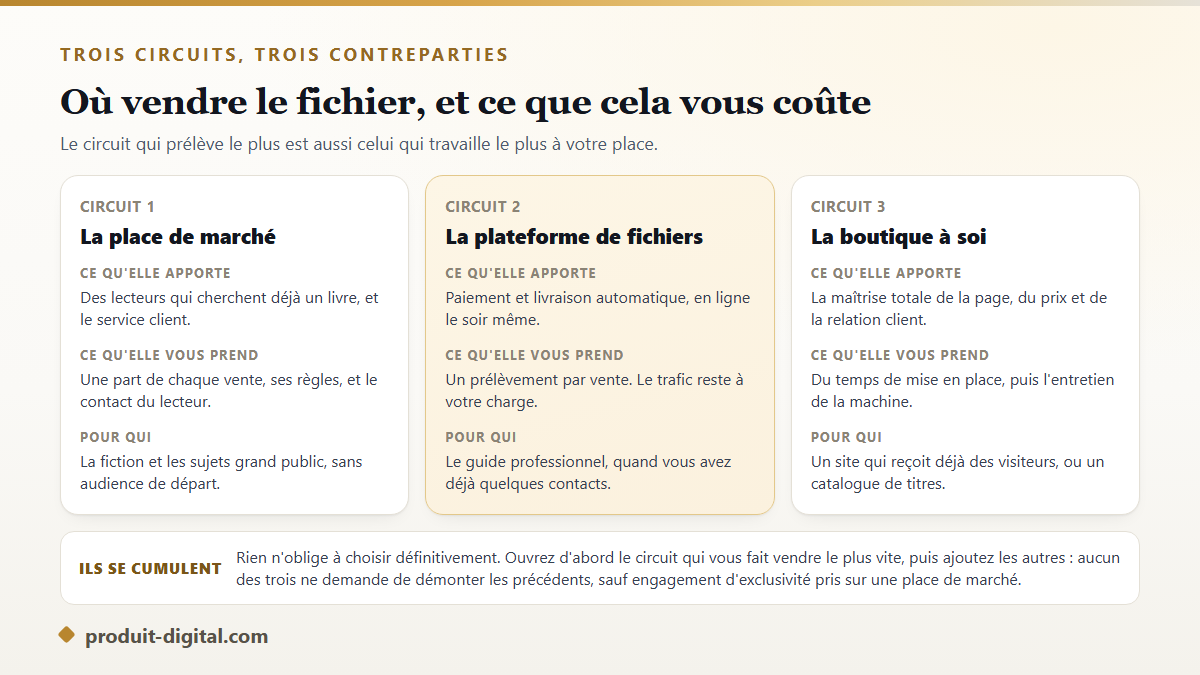
One thing never changes from one route to the next: you alone answer for the content and the quality of the file. No platform proofreads your book or checks that you hold the rights to the images inside it. What you delegate is the selling infrastructure, including the day a buyer complains.
The marketplace route
A marketplace is a store where readers already come looking for their next read. Amazon's Kindle store, Kobo, Apple Books and Google Play Books all work on this principle: you upload the file, they handle the listing, the payment, delivery to e-readers and part of the customer service. In return, they keep a share of every sale and impose their own framework on you, from the accepted file format to the price range you are allowed to use.
The point to know before signing up concerns exclusivity. According to the KDP Select program terms published by Amazon, enrolling commits the digital edition of the book to exclusivity for a period of ninety days, renewed automatically for as long as you do not switch it off. During that time you cannot sell the same file anywhere else, your own site included. Publishing outside the program remains possible and leaves the book free to circulate everywhere. It is a commercial strategy decision, not an administrative box to tick along the way.
The file-selling platform route
These services exist for one reason only: handing over a digital file in exchange for a payment, without you having to program anything. You create a listing, you upload the document, you get a page address, and the download link goes out to the buyer automatically. The fee applies to each sale, there is usually nothing to pay upfront, and going live takes minutes.
Their real advantage lies somewhere other than in the simplicity: you keep the buyer's email address, and with it the ability to tell that person about your next book. On a marketplace, this reader belongs to the platform and you will never know who they are. The trade-off is that no visitor lands on your listing on their own: you bring every single person who views it, which makes this route a counter rather than a store.
The route of your own shop
Selling on your own site means installing a product page, a payment module and a delivery mechanism, either with a shop extension or with a payment provider that sends the document once the money is in. Nobody takes a cut of the content sold any more, only the payment service fees remain, and you decide everything: the look, the bundles, the discount codes, the abandoned cart reminder.
The real cost of this path is the upkeep. A merchant site calls for updates, a valid certificate, a backup, and it breaks down at moments you do not get to choose. It becomes worth it when the sales volume justifies the attention it demands. For a first book, it adds weeks before the first sale, and that time goes neither into writing nor into finding readers. Our platform takes care of building the book, from the approved outline to the final file, precisely so that this energy stays available.
Which one to choose for your situation
The right route depends on the audience you already have, the time you can put into the setup and the nature of the book. A novel and a professional guide do not sell in the same place, because their buyers do not look for them in the same place.
- No audience, a work of fiction. The marketplace is the obvious choice: readers search there actively, which nobody does on a site they have never heard of. Free to upload, no costs to front.
- Professional know-how and a few contacts. The file-selling platform serves you better: your first buyers come from your network and you keep their address for what comes next. Account opened in an evening, listing free with most services.
- A site that already gets visitors. Sell directly on it: the traffic is there, all it lacks is somewhere to pay. More technical to set up, but no dependence on a third party.
- Institutional buyers, schools, libraries or companies. These organizations go through purchasing procedures that require an invoice in the organization's name. Check that the route you pick produces one before you commit.
- An illustrated book or a children's book. The layout carries as much meaning as the text, which rules out the channels that convert your document into their own format without letting you control the result.
The file you deliver
The format decides the reading experience, and therefore the reviews that get published. PDF keeps your layout exactly as it is, which makes it the only option for an illustrated book, a workbook or any document whose arrangement carries meaning. EPUB adapts to the screen size and lets the reader choose the typeface, which is better for continuous text read on an e-reader. Delivering both files in the same purchase costs one extra export and removes the question.
Two technical details often turn against the seller. Weight first: a file that is too heavy fails to download on an average connection and clogs the inbox if it goes out as an attachment, which takes seconds to fix with a compression tool. Protection next: a discreet watermark carrying the buyer's name discourages casual sharing without getting in the way of reading, where a technical lock always ends up blocking the legitimate reader rather than the one making copies.
The sales page, block by block
A sales page is not a product description, it is the proof that you have understood the problem of the person reading it. The order of the blocks matters more than their number: the visitor decides within seconds whether they are in the right place, and the headline and the cover do that work before anything else.
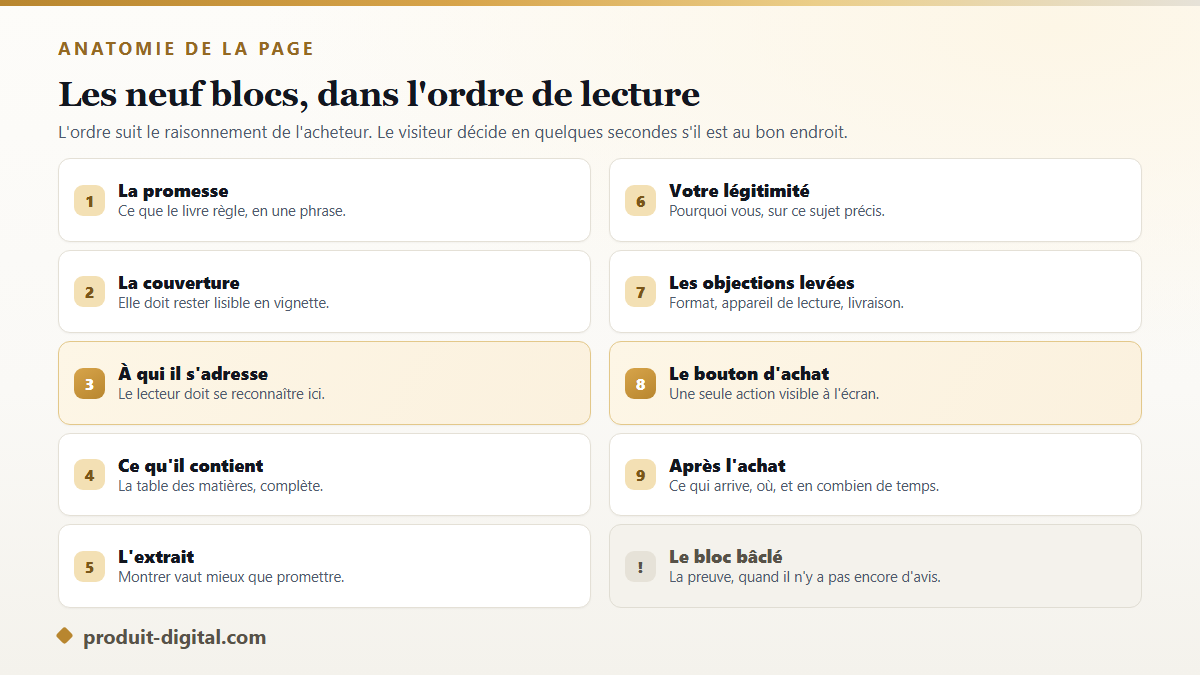
The block most often rushed is the proof. With no customer reviews at launch, show the book itself: preview pages, the full table of contents, an extract from the first chapter. That table of contents turns out to be remarkably effective for a guide, because it answers the one question that decides the purchase, whether the answer being looked for is in there. The visual does the rest, and a cover that stays readable as a thumbnail carries more weight than three paragraphs of arguments.
Getting paid: what happens between the click and your account
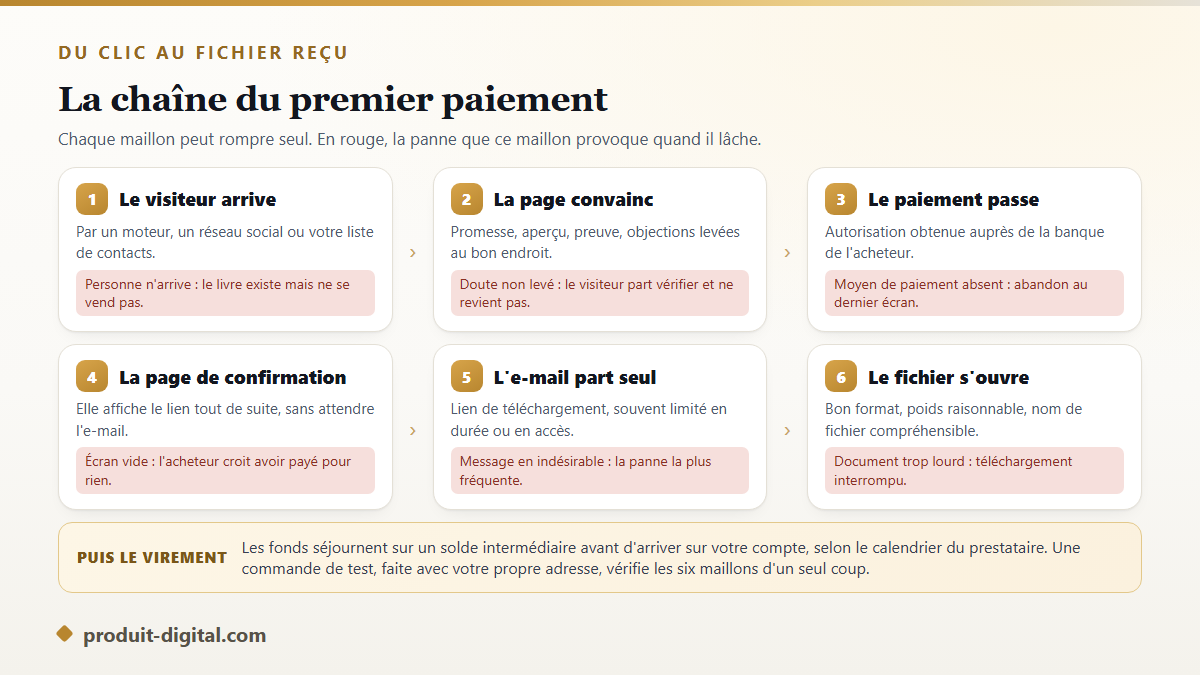
Online payment involves more players than the button lets on. The provider gets the authorization from the buyer's bank, the platform records the order, then the funds sit on an intermediate balance before being transferred to your account, often a few days after the sale. This lag catches new sellers off guard, as they see a confirmed order with no matching movement on their bank statement.
Two settings deserve your attention as soon as you go on sale. Depending on the countries you are targeting, the bank card is not enough to cover your buyers, and offering the digital wallets that are widespread there (mobile money in much of Africa, PayPal and the local wallets elsewhere) avoids people dropping out on the last screen. Then comes identity verification: providers ask for supporting documents before releasing the first transfers, a formality better dealt with before the launch than on the evening the orders start coming in.
Delivering the file without lifting a finger
Manual delivery holds up for the first few days, then becomes a trap. A buyer who pays at an hour when you are asleep does not understand the silence, and writes an anxious message before you have even seen the notification. The automatic route settles this: a validated payment triggers an email containing a download link, often limited in time or in number of accesses.
Place a test order with your own address before you open sales, and check that the message arrives in the inbox rather than the spam folder, that the link opens from a phone, and that the file has an understandable name instead of a string of characters. Plan for a confirmation page that shows the link straight away as well: the email sometimes takes several minutes to arrive, and those minutes are enough to worry someone who has just paid.
Setting the price without using the wrong benchmark
The price of an ebook follows neither from the number of pages nor from the time you spent on it, but from what the book saves its buyer: a guide that prevents a costly professional mistake sells for more than a novel of the same length, because the perceived value has nothing to do with it. Look at what the books answering the same need are charging on the channel you have chosen.
A very low price attracts less than you would think: it casts doubt on the quality and draws in the buyers who demand the most after-sales attention. The effect on what you earn is mechanical, since according to the royalty schedule published by Amazon for its KDP program, the rate paid to the author depends on the price range the book falls into, so that a slightly more expensive book can bring in more than a discounted one. Check that schedule before you decide. Our own plans are detailed on the pricing page.
Bringing buyers to the page
A sales page with no visitors produces nothing, and this is where the gap opens between a book that sells and a book that merely exists. Four traffic sources hold up over time: the search visibility of content published regularly, a contact list built from the very first sale, a steady presence on the network where your audience already spends time, and word of mouth. Pick one at the start and stick with it for several months before you judge it.
Extracts convince better than ads, because they show the actual content instead of promising its quality. A free chapter in exchange for an email address, an audio episode taken from the book or a short promotional film keep working long after they are published. If you would rather have other people carry part of that effort, selling through recommendation can be organized seriously, and our partner program rests on that principle.
What the law asks of you
Copyright calls for no prior step: the Berne Convention, which the vast majority of countries have joined, sets out protection acquired from the moment the work is created, with no registration formality. What you have to watch is the opposite, namely the embedded elements whose rights you do not hold. An image found through a search engine or a long quotation can expose you years after publication, hence the value of keeping a record of the origin and the license of everything you did not produce yourself.
Three obligations then depend on your country and on your buyers'. The ISBN, assigned by the national ISBN agency of your country, identifies the book in professional channels, and marketplaces do not all require one, Amazon assigning its own identifier to the books published there. Value added tax follows precise rules: in the European Union, a digital book sold to a private individual is taxed in the buyer's country of residence, which explains the single reporting counters opened by tax authorities.
The right of withdrawal, finally, deserves an explicit checkbox on your payment page. The European consumer rights directive provides that the buyer of digital content supplied immediately loses that right if they have expressly consented to the supply starting immediately and acknowledged that they thereby lose their ability to withdraw. Without that double statement, the buyer keeps the right and you will have to refund a file that has already been downloaded. As these rules remain national, the competent authority in your country is the only one to consult about your exact situation.
The mistakes that cost the most
They look much the same from one author to the next and nearly all of them can be put right, as long as you spot them early.
- Opening sales without a test order. A broken link on launch day turns your first buyers, the most enthusiastic ones, into refund requests.
- Selling the file without collecting the buyer's address. That contact is often worth more than the sale itself, because it makes the next book easier to launch.
- Accepting exclusivity without having decided on it. A box ticked at sign-up closes every other route for its whole duration and renews itself without warning you.
- Writing a page that talks about the book instead of talking about the reader. The number of pages has never convinced anyone to buy anything.
- Lowering the price out of caution. A discounted book rarely sells better, and it deprives you of the promotion that would genuinely have triggered sales.
- Stopping the promotion after launch week. Sales of a digital book build over months, the launch being only the first point on the curve.
Frequently asked questions
Do you need to register a business to sell an ebook?
Selling on a regular basis means having a declared status, whose form depends on the country where you are tax resident. Invoicing, tax and reporting rules vary from one state to another, including when you collect the money through a foreign platform. Ask your country's tax authority before the first sale: it is the only body entitled to answer for your case.
Can you sell an ebook without a website?
Yes, and it is in fact the most common situation. A marketplace or a file-selling platform provides the product page, the payment and the delivery. You get an address to share, which is enough to sell. The site becomes useful later, when you want to stop depending on someone else's rules.
PDF or EPUB, which format should you go with?
PDF for any document where the layout carries meaning: illustrated book, workbook, method with tables. EPUB for continuous text meant for an e-reader, since it adapts to the screen. If in doubt, deliver both files in the same purchase.
How do you stop the file from being shared?
No protection is completely effective on a file that is meant to be read. The reasonable measures are personalizing the document with the buyer's name, adding a discreet watermark and limiting the number of downloads. The best defense is still the update: a copy going around becomes out of date, while the legitimate buyer receives the current version.
Can you sell the same ebook on several channels?
Yes, unless you have signed up to an exclusivity program, in which case distributing it elsewhere is forbidden for the whole of its duration. Otherwise, publishing on several channels widens the surface where you can be discovered and protects you against an account being closed overnight. Our answers about how the service works are on the frequently asked questions page.
The setup described here takes a day's work for a first book, and the real difficulty has nothing technical about it: it consists of choosing the route that matches your situation, then sticking with it long enough for buyers to find you. If the book is still to be written or laid out, creating your account gives you the outline, the text, the illustrations and the final file in the right format, which keeps your energy for the part that decides everything, the selling.