Print on demand books changed one thing, and everything else follows from it: no copy exists until a reader pays for one. There is no garage full of cartons, no minimum order, no evening spent at the post office. A file sits on a server, an order arrives, a machine somewhere prints and binds a single copy, and it ships. Julien listed his first title on a Tuesday and shipped a copy to a stranger in another country on the Friday, without ever holding stock.
That freedom comes with a trade. Because each copy is manufactured alone, it costs more to make than a copy from a print run of a thousand, and that cost is deducted before you are paid. Your job is to build files that print cleanly, pick a printer whose network reaches your readers, and set a price that leaves something on the table. This guide walks the entire chain, in the order you will meet it.
The short answer
A print on demand book works like this: you upload a print ready interior PDF and a cover file sized to the final page count, the platform runs automatic checks, you order a proof and read it, then you set a list price and publish. From there, an order triggers manufacturing at the printing site nearest the buyer, the book ships, and the platform pays you the list price minus the printing cost and its own share. The two files are the only part you control, so a project that produces an interior and a cover that are export ready from the start removes most of the rejections that stall first time authors.
- Finish the interior: trim size, margins, fonts embedded, images at print resolution.
- Build the cover once the page count is final, since the spine width depends on it.
- Upload to one platform, fix whatever the automatic checks flag.
- Order a physical proof and read it end to end before anything goes live.
- Set the list price above the printing cost by a margin you can defend.
- Publish, then treat the listing page as the thing that actually sells the book.
What print on demand books actually are
A print on demand book is an ordinary printed book manufactured one copy at a time by a digital press, rather than a few thousand copies at a time on an offset press. The pages come off a high speed digital printer, the cover is printed separately on heavier stock, and the two are bound together, trimmed, and boxed. A reader receiving one has no way to tell it apart from a bookstore paperback, because at the level of the object there is nothing to tell apart.
The model exists because digital presses removed the setup cost that made short runs absurd. Offset printing requires plates, and plates are worth making only across a large volume. A digital press starts printing from a file with no setup at all, so the hundredth copy costs the same as the first. That is the whole economic idea, and it is what put self publishing within reach of people who could never have funded a print run. If you are still deciding between routes, our comparison of every path from manuscript to a book readers can buy puts print on demand next to the alternatives.
How the chain works, link by link
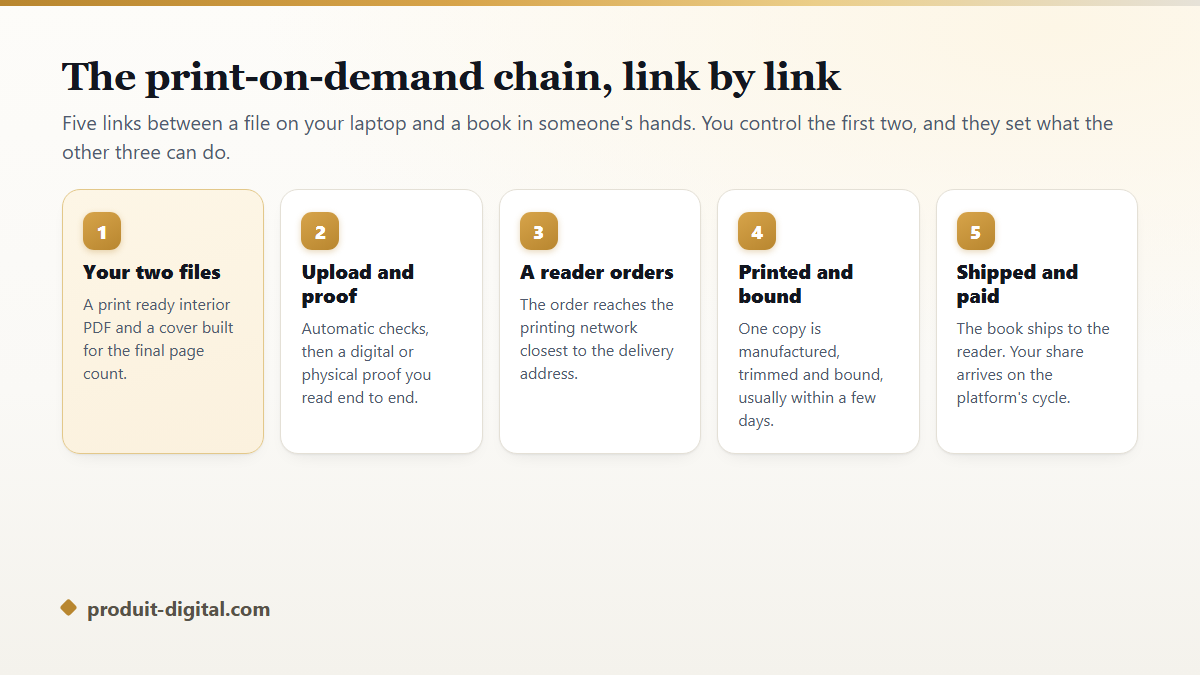
The first link is your files. An interior PDF at a trim size the printer supports, with margins that account for binding, and a cover file that wraps front, spine and back in one flat image. Nothing later in the chain can repair a mistake made here, which is why the file stage deserves more of your time than it usually gets.
The second link is upload and review. Every platform runs automatic checks on resolution, page size, embedded fonts and spine width, and returns a preview showing where each page will be trimmed. Read the preview, then order a printed proof. A proof is the only place you will catch a gutter that swallows the inside edge of an illustration, or spine text that sits a hair off center.
The third and fourth links belong to the printer. When a reader orders, the file is routed to the manufacturing site closest to the delivery address, which is how a book listed once can ship domestically in several countries. The copy is printed, bound, trimmed and packed, usually within a few working days, then handed to a carrier.
The fifth link is payment. The retailer collects from the reader, the printing cost is deducted, the platform keeps its share, and the remainder reaches you on a fixed cycle, typically a month or two after the sale. Nothing about that cycle is negotiable at your scale, so plan around it rather than against it.
Where the money goes on each copy
Three parties take a slice of every sale: the printer, the store, and you. The printer's slice is the manufacturing cost, which rises with page count, and jumps when the interior is in color rather than black and white. The store's slice is a percentage of the list price you set. Whatever is left is yours.
This produces one counterintuitive result that catches new authors. A long book earns less per copy than a short one at the same price, because the extra pages cost real money to print. Color illustrated books are the sharpest case: a picture book with full color interiors carries a manufacturing cost far above a plain text paperback of the same length, which is why illustrated titles are usually priced higher or sold as digital editions.
According to Amazon KDP's published terms, paperback royalties are calculated as a fixed share of the list price minus the printing cost, and the printing cost is disclosed before you publish. Other platforms use the same shape with different rates. Run the arithmetic on your actual page count before you write the description, not after, and if you want the full breakdown, our article on what a printed book really costs to produce, item by item works through it.
Print on demand or a print run: how to choose
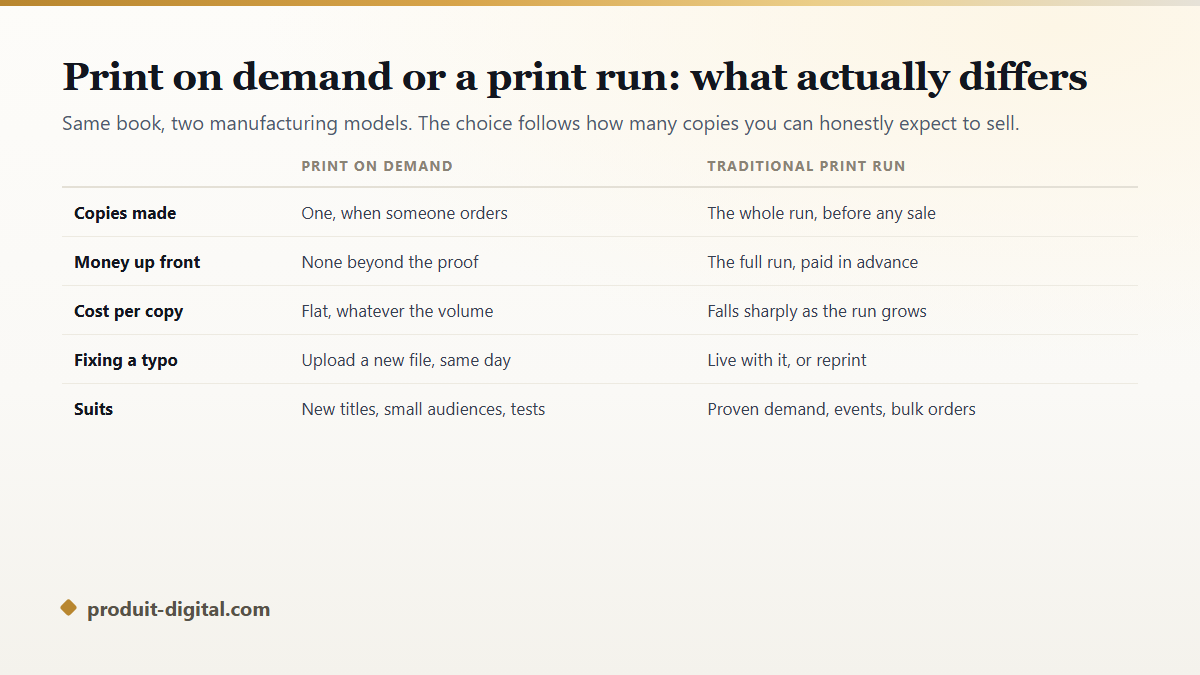
The honest test is how many copies you can move, and how certain you are of that number. Print on demand wins whenever demand is unknown, because the downside of being wrong is nothing at all. A print run wins once demand is proven and volume is high, because the per copy cost falls steeply as the run grows and can end up well below what on demand book printing charges.
There is a middle case worth naming. Authors who sell in person, at conferences or markets, often keep a title on print on demand for the store listing and order a small batch at author rates for events. That gives you a permanent listing with no stock risk, plus boxes to sell by hand when a crowd is coming.
The two files that decide everything
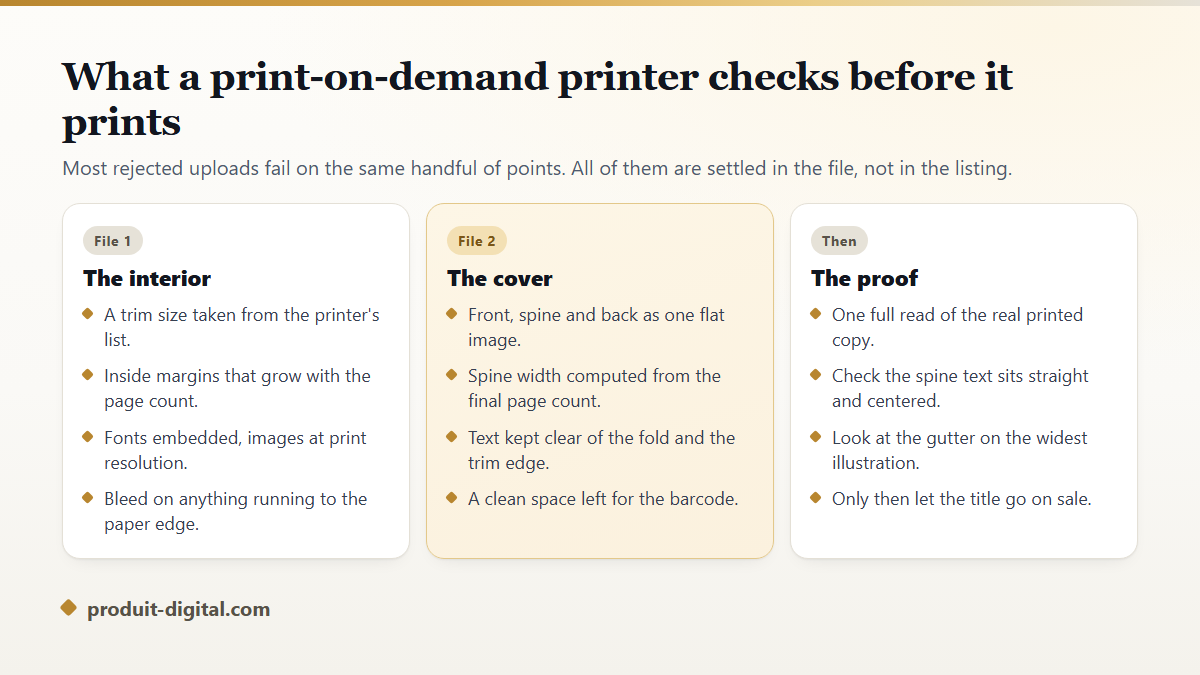
Your interior file needs a trim size taken from the printer's published list, not invented. Inside margins have to grow with the page count, because a thick book curves more at the spine and steals more of the inner edge. Fonts must be embedded so the press does not substitute them. Images belong at print resolution, which is several times what a screen needs, and anything running to the paper edge needs bleed built in from the start.
Your cover file is a single flat image covering back, spine and front, with the spine width computed from the final page count and the paper thickness the printer uses. Every platform publishes a template generator for this. Use it. Keep text away from the fold and away from the trim edge, and leave the space the retailer reserves for the barcode clear of anything you care about.
- Trim size chosen from the printer's list before you lay out a single page.
- Inside margin sized for the page count, outside margins even across spreads.
- Fonts embedded, images at print resolution, bleed on full page artwork.
- Cover built last, from the final page count, using the platform's template.
- A printed proof read once from cover to cover, out loud if it is short.
Choosing a print on demand company
Platforms differ on four things that matter and one that does not. Distribution reach, trim sizes and binding options, paper and color quality, and how the payout is calculated are the four. Interface polish is the one that does not, because you will use it a handful of times a year. A closer look at how the main printers compare on reach, formats and file rules is worth reading before you commit a title, since moving a published book between platforms means a new listing and a lost review history.
- Where the printing network sits, and which countries get domestic shipping.
- Which trim sizes, papers and bindings are offered, including hardcover.
- Whether color interiors are available at a standard and a premium grade.
- Whether the platform sells directly, distributes to other stores, or both.
- Whether you can order author copies at manufacturing cost for events.
- How quickly a corrected file replaces the live one after an update.
One question people forget: can you use your own ISBN? Some platforms give you a free identifier tied to their store, which is convenient and limits where the book can travel. Buying your own, according to the ISBN standard's guidance, keeps you listed as the publisher of record across every retailer. For a catalog you intend to grow, that matters.
Book printing on demand for books that are not novels
Fiction is the smallest part of what moves through these presses. Book printing on demand carries workbooks, journals, planners, recipe collections, photo books, church anniversary volumes, wedding albums, training manuals sold alongside a course, and the whole category of low content books built from repeated interior pages. Each has its own format habits: workbooks want a larger page so people can write, photo books want a square trim and premium color paper, journals want a page count that opens flat.
Illustrated children's books deserve a warning of their own. They need color interiors, they are usually short, and short color books carry a high manufacturing cost relative to what parents expect to pay. Authors solve it by choosing a smaller trim, by accepting a thinner margin on paperback and earning on a digital edition, or by treating the printed copies as gifts and keeping the commercial version digital.
What print on demand does badly
Speed to the reader is the first weak point. A copy has to be manufactured before it ships, which adds days a warehouse would not. During gift season that gap widens exactly when buyers are least patient, so state a realistic delivery window.
Special finishes are the second. Foil stamping, spot varnish, deckled edges, unusual paper stocks and custom die cuts are print run territory. Digital presses offer a fixed menu of papers and laminates, and no amount of asking widens it. If the object itself is the point, price a short offset run instead.
Bulk is the third. A school ordering three hundred copies pays a per copy cost that no discount fixes, because there is no discount to give. That is the moment to quote a print run and keep the on demand listing for individual readers.
A realistic first title, start to finish
Amandine finished her manuscript in March. She chose a trim size in the same week, which meant the layout was built once instead of twice. She laid out the interior, exported a PDF with fonts embedded, and only then designed the cover, because the spine width was finally knowable. The proof arrived nine days later with two problems: a running head repeating on chapter openers, and a photograph that lost its left edge in the gutter. Both were file fixes, and the corrected version went live within a week. If you want that same sequence from the printer's side, our guide to the printing options open to a small run covers what each one asks of your files.
The part she underestimated was the listing. A print on demand book competes on a screen, against thumbnails, so the cover has to read at the size of a postage stamp and the description has to answer who the book is for in its first line. The manufacturing chain is solved. Getting someone to click is the work that remains.
Mistakes that cost the most
- Designing the cover before the page count is final, which makes the spine wrong.
- Using screen resolution images, which print soft and cannot be fixed at the press.
- Publishing without ordering a proof, then discovering the error in a reader's review.
- Choosing a custom trim size that limits which stores can carry the book.
- Pricing from what feels fair instead of from the printing cost of your actual page count.
- Uploading a Word document export without checking how the PDF handled the fonts.
Most of them share a cause: the file was treated as an afterthought once the writing was done. Building the manuscript in a workspace that already produces a PDF laid out to a printer's requirements removes that last mile, which is where first titles usually lose a month.
Frequently asked questions
How much does it cost to start with print on demand books?
Uploading and listing a title is free on the major platforms. Your only unavoidable outlay is the proof copy, which you pay for at manufacturing cost plus shipping. Everything else, cover design, editing, an ISBN, is optional.
How long does a print on demand book take to reach a reader?
Manufacturing usually takes a few working days, and shipping is added on top. Domestic delivery through a large network often lands within a week, while cross border orders can take considerably longer. Put a realistic window in your listing, because unstated delivery time is a common source of poor reviews.
Can I sell the same book on several platforms?
Usually yes, as long as you have not accepted an exclusivity program. Amazon's KDP Select, for example, requires digital exclusivity in exchange for its promotional features, and its terms set out exactly what that covers. Paperback editions are generally free to appear elsewhere, but read the agreement you signed rather than a summary of it.
Is the printing quality as good as a bookstore edition?
For text interiors, the difference is invisible to a reader. For heavy color work, offset printing still holds an edge on color depth and paper choice, though premium color grades on demand have closed much of the gap. Order a proof and judge with your own eyes.
What happens if I find a mistake after publishing?
You upload a corrected file and it replaces the live one, usually within a day or two. Copies already printed are unaffected, but nothing further is manufactured from the old version. That single ability is the strongest practical argument for on demand book printing over a garage full of cartons you cannot fix.
Your file is the whole business
Everything downstream of your two files is machinery you do not have to think about: presses, carriers, payouts, all of it runs the same way for a first time author as for a publisher. What separates a title that sells from one that sits is the quality of the interior, the readability of the cover at thumbnail size, and a listing that names its reader. Get those right and print on demand books stop being a compromise and start being the sensible way to publish. When your manuscript is ready to become a real interior and a real cover, open an account and export the files.