You have been carrying an idea for months, maybe years. The start of a chapter in a notebook, a folder of notes that keeps growing, and the same feeling every time you sit down at the keyboard: the project is too big to begin today. Yet writing a book depends on neither talent nor inspiration. It depends on a method and on regularity. The authors who reach the end are almost never the ones who write the best first draft, they are the ones who set up a system simple enough to hold for several months without renegotiating it every morning.
This guide follows the whole path, in the order you actually travel it: finding an idea that can carry the length, building an outline, holding a pace, developing characters or a teaching progression, revising, getting the text read, then turning a word processor file into a book. If your manuscript is already under way, you can go straight to the revision section, or pick up a text you have already written without retyping it and move on to layout.
The short answer
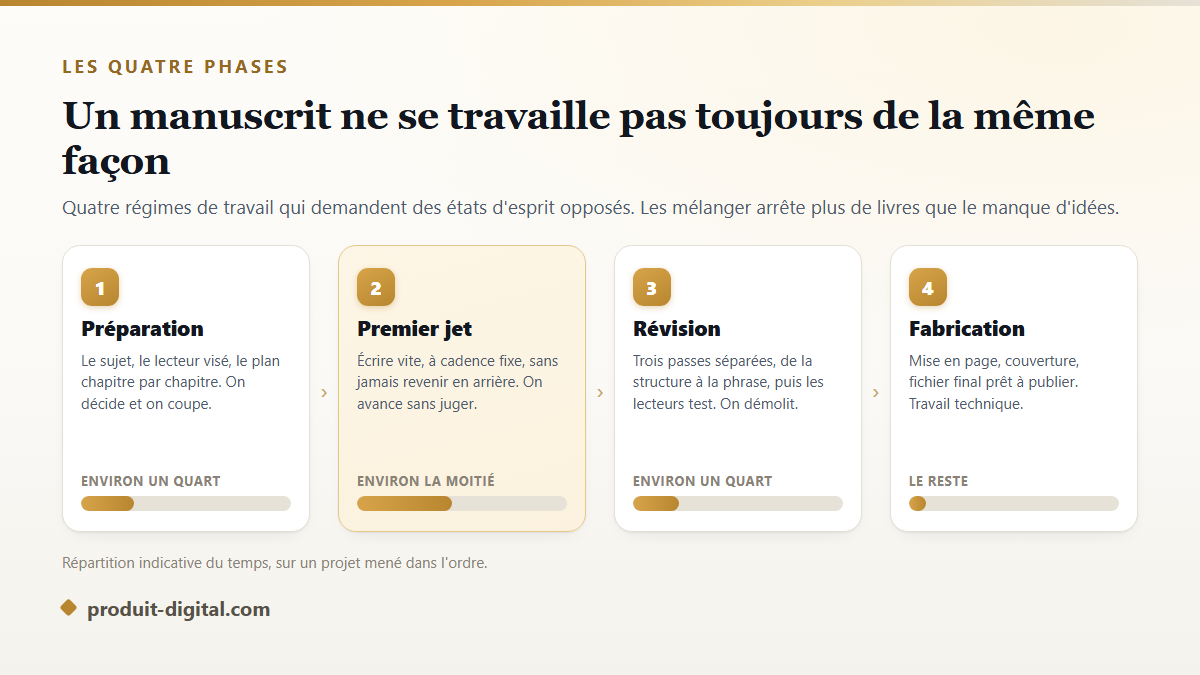
A book gets finished in four phases, and none of them can be skipped without a cost. Preparation sets the subject, the intended reader and the outline: half of the final quality is decided there. The first draft is written fast, without rereading, at a fixed pace, until the last full stop. Revision runs in three separate passes, from structure down to sentence. Production turns the text into a readable object, with its layout, its cover and its final file. For a first book, count on three to nine months depending on the format and the time you have each week. The variable that decides is not talent, it is regularity: a thousand words three times a week brings a complete novel manuscript in six months, while one long writing day a month never gets there.
Writing a book: the four phases between the idea and the final full stop
The most expensive confusion is treating writing as a single activity. A manuscript goes through four working modes that call for opposite states of mind: you decide and you cut during preparation, you move forward without judging during the first draft, you tear down what you have just built during revision, then you deal with margins and files during production. Mixing these modes stops more manuscripts than any shortage of ideas, because the critic and the producer cannot occupy the same working hour.
The way the time splits often comes as a surprise. On a finished book, the drafting itself rarely takes more than half the project, preparation takes a good quarter when it is done seriously, and revision as much again. An author who starts writing on day one does not remove the preparation, they spread it across the whole manuscript, producing chapters they will end up throwing away.
Finding an idea that holds over the distance
A book idea is not a theme. A novel about grief or a guide to productivity is not enough to carry two hundred pages, because nothing in that tells you what happens, or for whom. What holds over the distance is a situation with tension: someone wants something, and something stands in the way. For a practical book, the equivalent is a measurable promise: by the last page, the reader can do one precise thing they could not do on the first.
The test that settles it fits in a single sentence, written down in black and white. A novelist has to be able to say who wants what, what stands in the way, and what happens if they fail. The author of a practical book has to name their reader, the problem being dealt with, and the state the reader is left in at the end. If that sentence takes three lines or stays vague, the project is not ready. Writing it takes an hour and saves weeks of chapters going in circles.
When several ideas compete for the slot, keep the one you have personal material for: something you have lived through, a job you have done, a question that has occupied you for years. Research can be caught up on, familiarity with a subject cannot be manufactured in three weeks.
The outline, the decision that saves the most time
The outline is the only place where a structural mistake can be fixed in a few minutes. Once forty thousand words are written, moving a chapter means rewriting the transitions, the callbacks, the setups and often half the scenes involved. Authors who write without an outline do not save time, they simply move the organising work to the moment when it costs the most, which is revision.
A useful outline fits on two pages and gives, for each chapter, three pieces of information: what happens in it, what the reader learns or feels there, and why that chapter cannot be cut. The third one is the most valuable, because it eliminates decorative chapters before they are written. A chapter you cannot find a reason to keep does not have one, and the reader will notice before you do.
The practical difficulty is that you validate your own outline badly, since you are too deep inside it to see the gaps. That is what pushed us to make a checkpoint compulsory before drafting, where the full outline is reviewed and corrected before the first line is written, chapter by chapter, with the option to move, merge or delete a section while nothing has been drafted. A fix then costs a minute instead of a week.
Holding a pace, the variable that really decides
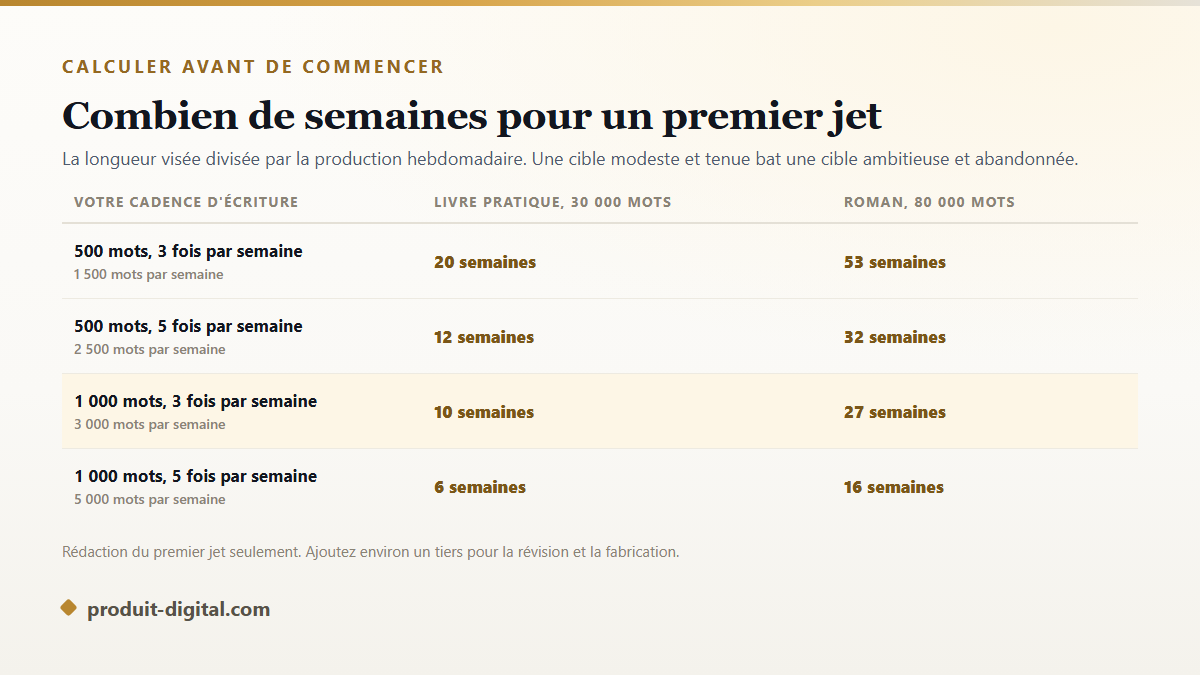
A manuscript is finished by accumulation, not by momentum. The useful question is therefore not how many hours you have ahead of you, but what volume you can produce each week without arguing with yourself. A modest target you hold beats an ambitious one you abandon: five hundred words per working day comes to more than a hundred and twenty thousand words in a year, without a single painful day.
Set the pace in words rather than in time. An hour of writing dissolves easily into rereading and research, whereas a word count can be checked. Then pick a fixed slot and defend it: the authors who write early in the morning are no more virtuous than the rest, they are using the one moment nobody can take from them. Record the total you reach each day in a table, because the streak of consecutive days quickly becomes the best engine of the project.
The NaNoWriMo writing challenge popularised a target of fifty thousand words in thirty days, roughly one thousand six hundred and sixty-seven words a day. That pace holds for a month, rarely for six. For a long project, a target between five hundred and a thousand words per session, three to five times a week, can be kept up without exhausting the author or their personal life.
The first draft is written without rereading
The first draft has one mission: to exist in full. Its quality does not matter, because no published text looks like its first draft. Rereading yesterday's pages before starting again is the most common trap: you fix commas while the session runs out, and the manuscript does not move a line. Many people who want to write a book stop exactly there, convinced they have been working.
Two habits protect your speed. Leave a marker wherever you get stuck, a tag you will find again later, instead of interrupting the session to check a date or come up with a street name. And stop in the middle of a scene you know how to write: picking up the next day becomes easy, since you have nothing to decide, only to finish what was already under way. Ernest Hemingway was already describing this method in his interviews about his work.
Characters a reader remembers
A character does not exist through their physical description, they exist through what they want and what they refuse. A reader remembers a thwarted desire, not the colour of someone's eyes. Before writing, give each main character a conscious goal, a fear that works against it, and a contradiction: the cautious one who takes an unreasonable risk just once, the generous one who cannot accept a gift. The contradiction is what makes a character alive rather than functional.
The character sheet is there for consistency, not for inspiration. Twenty lines are enough: what they want, what they fear, the past that matters to the plot, the way they speak, and the concrete details you have already put in the text, such as an age, a job, a scar or a favourite object. Without that record, inconsistencies settle in quietly, and it will be a reader who points out at chapter twenty that the eyes changed colour along the way.
The problem shifts when the book is illustrated, especially for children: the character then has to stay identical from one image to the next, something most image generators cannot hold over thirty pages. That is the point we dealt with first, with the same hero kept across every illustration in a book, so a child recognises the character page after page.
For a practical book, the promise replaces the plot
A practical book holds together through its progression the way a novel holds together through its tension. The reader has to feel that they are moving forward and that each chapter brings them closer to the result promised on the cover. The sturdiest structure follows the reader's real path, in the order they meet the difficulties, and not the logical order of the subject as the expert sees it. Those two orders rarely coincide, and it is the first thing a test read reveals.
Three things separate a manual people abandon from a book people finish: one concrete example per concept, one action they can carry out at the end of each chapter, and titles that promise a result rather than a theme. Choosing your keywords announces a subject, whereas finding the ten searches that will bring you readers announces a result. The second title makes you want to read on, and it forces the author to deliver what was promised.
The six blocks that stop a manuscript
Abandoned manuscripts are almost always abandoned in the same place, between the first quarter and the halfway mark, once the novelty has worn off and the end is still far away. The causes are few, they can be spotted from a distance, and each one has a concrete answer.
- The blank page in the morning. It comes from a decision you did not make the day before. End each session by writing down the first sentence of the next one, even roughly.
- The sagging middle. The beginning and the end were clear, the centre was not. Add a complication that changes the character's goal, or, for a practical book, a chapter built on a real case.
- Compulsive rereading. Correcting without moving forward gives the illusion of work done. Forbid yourself from going back until the final full stop is in place.
- Comparison with published books. You are comparing your draft to texts revised ten times and corrected by professionals. The comparison makes no sense at this stage.
- Endless research. Documenting your subject stays useful right up to the point where it becomes an elegant way of not writing. Set a time limit, then write with gaps to fill in later.
- Losing the point of the project. Reread the opening sentence, the one that says who wants what, or what the reader will be able to do. If it no longer convinces you, it is the project that needs adjusting, not your discipline.
Revision runs in three passes
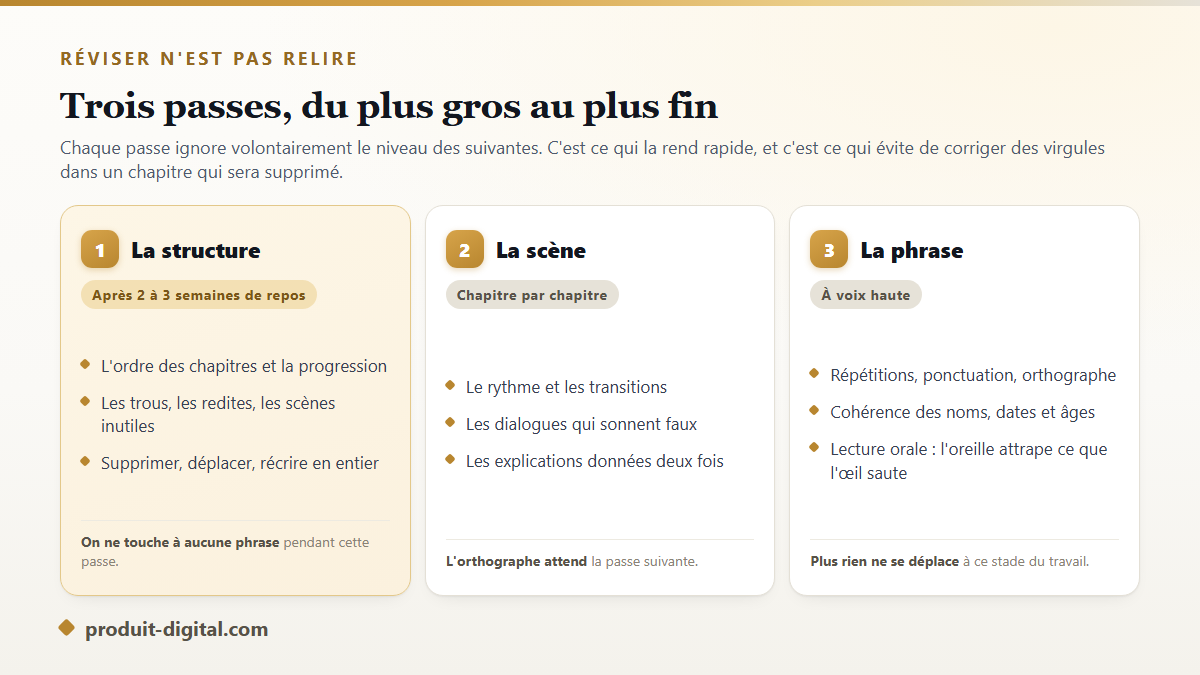
Revising is not rereading. A general reread mixes up questions that do not belong on the same level, and your attention gets lost in commas before you notice that a whole chapter is useless. Three distinct passes, run in that order, are worth more than ten vague rereads spread over six months.
The first pass touches no sentence, it questions the structure. Does each chapter earn its place, does the progression hold, is there still a gap or a repetition. This is the pass that cuts, moves, and sometimes rewrites a whole chapter. Let the manuscript rest for two to three weeks before you start it, because without that distance you reread what you meant to write instead of what is actually on the page.
The second pass works on the scene and the paragraph: pace, transitions, dialogue that rings false, redundant explanations. The third deals with the sentence and the spelling, out loud if you can, because the ear catches what the eye skips. On a long text, consistency becomes a job in its own right, with its dates, its names, its ages and its details announced then forgotten: a continuity check across the whole book spots in one pass what a human reader lets slip after three hours of reading.
Getting the manuscript read before you publish
No author sees their own text. After six months inside it, you fill in the gaps mentally and you hear the music you intended, not the one that is written. Three to five readers are enough, chosen among people who read the genre of your book and who owe you nothing. A well-meaning relative will tell you it is good, which teaches you nothing you can use.
Ask closed questions rather than asking for a general opinion. At what page did you want to stop, which character felt pointless, what did you misunderstand, where did you get bored. Vague feedback cannot be acted on, whereas a precise spot where three readers dropped out points to a real problem. Listen to the diagnosis and be wary of the cures they suggest: readers sense correctly where it breaks down, rarely why.
Novel or practical book: what really changes
The two projects share the daily discipline and the three revision passes. Everything else differs, from the expected length to the way you hold the reader, and confusing the two methods produces either a wordy novel or a guide that repeats itself.
- Usual length. Writing guides and publishers' submission guidelines most often place a first novel between sixty thousand and ninety thousand words, while a practical book reads very well between twenty-five thousand and forty thousand.
- The outline. A novel tolerates a loose framework with room for improvisation, whereas a practical book calls for an outline detailed right down to the subheading.
- Preparation. Character sheets and a timeline for fiction; research, examples and exercises for the practical book.
- Revision. Fiction is judged on pace and credibility, a practical book on the usefulness of every page, tested by a reader who really applies the method.
- The role of images. Rare in adult fiction, often central in children's books and in practical ones, where a diagram replaces two pages of explanation.
- How easy it is for a beginner. A practical book is shorter, more sign-posted, and gets finished more often. A novel teaches you more about writing itself.
The moment a manuscript becomes a book
A word processor file is not a book. Going from one to the other calls for a layout designed for reading, with its margins and its line spacing, a cover that works as a thumbnail, a table of contents, and a file that stays stable on every device. This stage decides the credibility of the book before a single line has been read.
A cover is judged shrunk to the size of a stamp, since that is how it appears in a list of results: a short title, strong contrast, two levels of information at most. Producing the cover and exporting a PDF ready to publish belong to the same movement, because printing constraints such as bleed, inner margin and image resolution are settled during layout and are hard to put right afterwards.
If your text already exists, there is nothing to retype: the online editor picks the manuscript up chapter by chapter so you can correct it, illustrate it and export it in the same place. To adjust a file you have already produced, the free PDF tools on the site let you reorder pages, reduce the file size or add page numbers without installing any software.
Frequently asked questions
How long does it take to write a book?
Count on three to nine months for a first book with a regular practice. Divide the length you are aiming for by your weekly output, then add about a third for revision and production. A practical book of thirty thousand words, written at three sessions of a thousand words a week, takes ten weeks of drafting and about four months in total.
Do you need an outline before writing a book?
Yes for most authors, and even more so for a first book. Writing without an outline remains possible in fiction, provided you accept a long structural revision, since the organising work then happens afterwards on a text that is already written. For a practical book, the outline is not negotiable: without it the text repeats itself and the reader feels no progression.
How do you protect a manuscript before publication?
The Berne Convention, which the vast majority of countries have signed, states that protection of a literary work arises from its creation and depends on no registration formality. Your manuscript is therefore protected as soon as it is written. What is missing in a dispute is proof of the date: a deposit with a recognised body, a timestamped mailing or a registration service fills that role. Legal deposit rules depend on the country of publication and apply to the publisher, including when the publisher is the author.
Which software should you use to write your book?
A word processor is enough for the first draft, and many published authors use nothing else. Dedicated tools become useful at revision, when you have to move chapters, track characters, check consistency and produce a clean file. That is what our writing and layout platform brings together, from the validated outline to the file ready to publish.
Do you need an ISBN to publish your book?
An ISBN identifies one specific edition of a book, and the ISO 2108 standard sets its structure. It is assigned by the national agency of the publisher's country, AFNIL in France. It is not a legal obligation in most countries, but booksellers and distributors ask for it in practice. According to Amazon KDP's documentation, the platform provides a free identifier for paperbacks published there, usable only within its own network: if you are aiming for bookshops, buy your own ISBN from your country's agency.
Can artificial intelligence write the book for me?
It drafts fast and suggests phrasings, but it does not know what you have lived through or what your reader is specifically waiting for. Fully generated texts resemble one another, because they are produced from the same averages. The use that works is a two-handed job: you decide the outline, the angle and the examples, the tool speeds up the drafting and the formatting, then you rewrite whatever rings false. A book that finds its readers always keeps the mark of its author.
The manuscript that gets finished is not the one written by the most gifted author, it is the one written by the author who set an outline, held a modest pace and agreed to revise three times. If your idea is already there, the next step takes an hour: write the sentence that says what your reader will know or feel on the last page, then draw the chapter outline out of it. Creating your account lets you lay down that outline, correct it before the first line, and keep the thread all the way to the final file.